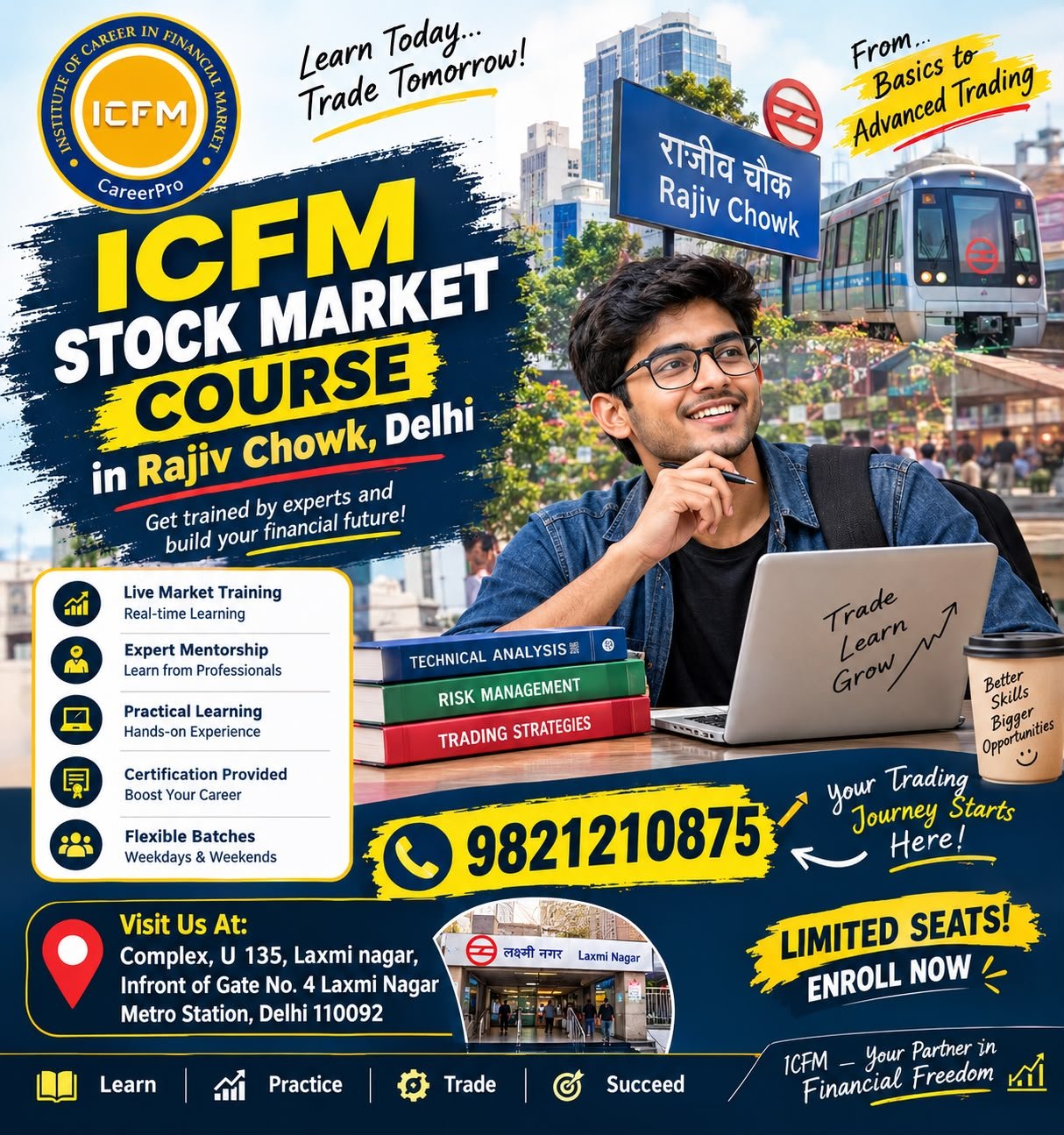
Learn stock market trading and investment with ICFM’s Stock Market Course in Rajiv Chowk. Build practical skills in technical analysis, fundamental analysis, risk management, and market research.
Searching for a Stock Market Course in Rajiv Chowk that goes beyond basic theory?
Learning the stock market requires more than knowing how to buy and sell a share. A serious learner needs to understand market structure, price movement, technical analysis, fundamental research, risk management, trading psychology, and the practical use of market tools.
ICFM – Institute of Career in Financial Market offers structured stock market education designed to help students, beginners, working professionals, investors, and aspiring finance professionals develop practical knowledge of the financial markets.
Instead of approaching the stock market as a collection of random tips and strategies, ICFM focuses on building a systematic understanding of how markets work and how traders and investors can evaluate opportunities responsibly.
Whether you are starting from zero or already have some market experience, the course is designed to take your learning from fundamentals to practical market application.
Why Learn the Stock Market Professionally?
The growth of online trading platforms has made market participation easier than ever. Opening a trading account and placing an order may take only a few minutes.
But easy access to the market does not automatically mean easy decision-making.
A learner should understand questions such as:
Why does a stock price move?
How can a chart be interpreted?
What is the difference between trading and investing?
How are support and resistance identified?
How do technical indicators work?
How should a company be evaluated?
What is position sizing?
How can risk be managed?
How do market trends influence individual stocks?
How should a trading plan be developed?
A professional Stock Market Course in Rajiv Chowk can help bring these concepts together into one structured learning framework.
The objective is not to promote unrealistic profit expectations. The objective is to develop knowledge, analytical skills, discipline, and practical market understanding.
ICFM Stock Market Course in Rajiv Chowk
ICFM provides financial-market education with a practical and career-oriented approach.
The course combines classroom learning, market concepts, analytical techniques, trading tools, investment principles, and career-oriented guidance.
The learning journey includes:
Understand → Analyse → Practise → Manage Risk → Develop Strategy → Build Market Skills
This approach helps learners understand not only what happens in the market, but also the reasoning behind different trading and investment decisions.
What Makes This Course Different?
Many beginners start their market journey by watching scattered videos, following social-media opinions, or trying strategies without understanding their limitations.
That can make the learning process confusing.
ICFM follows a more structured approach.
1. Start with the Fundamentals
Before studying advanced strategies, learners develop an understanding of:
Stock exchanges
Equity markets
Market participants
Primary and secondary markets
Trading accounts
Demat accounts
Order types
Market indices
Corporate actions
Basic market terminology
This creates the foundation required for advanced learning.
2. Move Into Technical Analysis
Once the fundamentals are clear, learners can study how price and volume information can be interpreted through charts.
Topics may include:
Candlestick analysis
Chart patterns
Trend identification
Support and resistance
Breakouts and breakdowns
Moving averages
Momentum indicators
Volume analysis
Price action
Market structure
Intraday concepts
Swing-trading concepts
The focus is on understanding the logic behind technical analysis rather than simply memorising indicator signals.
Fundamental Analysis for Smarter Investment Research
Trading is only one part of the financial market.
For learners interested in investment, understanding a company's financial position is equally important.
The course introduces learners to areas such as:
Financial Statements
Balance sheet
Profit and loss statement
Cash-flow statement
Revenue and profitability
Debt and liabilities
Company Analysis
Business model
Competitive position
Management considerations
Growth factors
Industry environment
Valuation Concepts
Earnings
Valuation ratios
Market capitalisation
Comparative analysis
Investment-oriented research
This helps learners understand how fundamental analysis can complement market and price analysis.
Trading Tools and Market Platforms
Modern market education should include practical familiarity with the tools used by traders and investors.
Depending on the course structure, learners can develop familiarity with tools and platforms used for:
Chart analysis
Market scanning
Price and volume analysis
Research
Order placement
Market monitoring
Technical studies
The goal is to make learners comfortable navigating the practical side of financial markets rather than limiting education to textbook concepts.
Risk Management: An Essential Part of Market Education
One of the most important areas of stock market learning is often overlooked by beginners: risk management.
A strategy is not complete simply because it identifies a potential entry.
Learners should also understand:
How much capital is being exposed
Where risk should be defined
Position sizing
Stop-loss concepts
Risk-to-reward concepts
Portfolio diversification
Capital allocation
Trading discipline
There is no guaranteed strategy for making profits in financial markets. Good market education therefore needs to teach both opportunity analysis and risk awareness.
ICFM incorporates risk-management concepts into the learning process so students can approach market participation with greater discipline.
Trading Psychology and Decision-Making
Markets are influenced not only by numbers and charts but also by human behaviour.
Fear, greed, impatience, overconfidence, and emotional decision-making can affect trading behaviour.
Learners can therefore benefit from understanding:
Trading discipline
Emotional control
Avoiding impulsive decisions
Following a predefined plan
Maintaining a trading journal
Learning from mistakes
Managing expectations
Developing a process can be more useful than continuously searching for the next market tip.
Who Can Join the Stock Market Course in Rajiv Chowk?
The course can be useful for learners with different goals and experience levels.
College Students
Students interested in finance can use structured market education to develop practical knowledge alongside their academic studies.
Beginners
No previous professional trading experience is necessary to begin with the fundamentals.
Working Professionals
Professionals can learn market concepts as an additional financial skill and explore how it fits into their longer-term career or personal learning goals.
Investors
Existing investors can strengthen their understanding of company analysis, valuation concepts, market behaviour, and portfolio-related principles.
Aspiring Traders
Those interested in trading can study technical analysis, market structure, risk management, and strategy development in a structured environment.
Career Changers
People considering finance-related career paths can develop foundational knowledge before exploring professional roles in areas such as broking, research, dealing, and financial services.
From Beginner Concepts to Advanced Market Understanding
A strong learning program should have a logical progression.
ICFM's learning approach can be viewed through several stages:
Stage 1 – Market Foundation
Understand the language and structure of financial markets.
Stage 2 – Chart & Price Analysis
Learn how market data can be interpreted using technical-analysis concepts.
Stage 3 – Company & Investment Analysis
Understand how financial information and business fundamentals can be studied.
Stage 4 – Practical Application
Work with charts, market data, research methods, and trading concepts.
Stage 5 – Risk Management
Learn how risk can be identified, measured, and managed.
Stage 6 – Strategy Development
Understand how traders can create and test a systematic approach.
Stage 7 – Career Preparation
Explore relevant finance-sector roles and develop professional skills.
This progression creates a more complete learning experience than studying isolated trading tips.
Career Paths After Learning Stock Market Skills
A stock market course does not guarantee employment or trading profits. However, structured financial-market education can provide useful foundational knowledge for exploring several career areas.
Depending on qualifications, experience, and applicable regulatory requirements, learners may explore roles such as:
Equity Dealer
Research Executive
Financial Market Associate
Trading Desk Assistant
Investment Operations Executive
Client Relationship Executive
Equity Research Support
Market Research Associate
Portfolio Support Roles
Financial Market Trainer
Learners interested in professional advisory or research roles should also understand the relevant regulatory and qualification requirements applicable to those positions.
Why Rajiv Chowk Is a Convenient Learning Location
Rajiv Chowk is one of the major commercial and connectivity hubs in Delhi.
Its location makes it accessible to students and professionals travelling from several parts of the city.
For learners who work or study around central Delhi, choosing a Stock Market Course in Rajiv Chowk can make regular participation in classroom training more convenient.
For learners who cannot attend every session physically, online learning options can provide additional flexibility.
Classroom Learning + Practical Market Education
Financial markets are dynamic.
A good learning environment should therefore encourage students to connect classroom concepts with actual market observations.
Rather than simply memorising definitions, students can learn to ask:
What is happening?
Why might it be happening?
What information supports the observation?
What risks are involved?
How can the idea be tested?
This analytical mindset can help transform stock market education from passive learning into active skill development.
Why Choose ICFM for Stock Market Education?
ICFM – Institute of Career in Financial Market focuses on financial-market education with an emphasis on practical learning and professional development.
Key areas of the learning experience include:
Practical Orientation
Concepts are connected with market examples and practical applications.
Structured Curriculum
The learning path moves from foundational concepts toward technical, fundamental, and risk-management topics.
Experienced Guidance
Students receive guidance while developing their understanding of financial-market concepts.
Career Focus
The program also addresses professional development and possible career paths within the financial-services industry.
Flexible Learning
Depending on the program and batch, learners can explore classroom and online learning formats.
Continued Guidance
Learners can receive support for doubts and further understanding of market concepts.
What You Should Look for Before Choosing a Stock Market Course
Choosing a course should not be based only on advertisements or claims about potential earnings.
Before enrolling, learners should consider:
1. Curriculum
Does the course cover the concepts you actually want to learn?
2. Practical Exposure
Does the learning process connect theory with real market data?
3. Faculty Experience
Are instructors able to explain concepts clearly and practically?
4. Risk Education
Does the program discuss risk management and trading discipline?
5. Career Support
If your objective is employment, does the institute provide relevant career guidance?
6. Learning Format
Are classroom or online options suitable for your schedule?
7. Transparency
Are course structure, fees, duration, and support clearly communicated?
Making these checks can help learners select education based on their actual requirements rather than promotional claims.
A Practical Learning Environment for Future Market Professionals
The financial sector includes much more than buying and selling stocks.
It includes research, analysis, broking, investment operations, portfolio management, wealth management, financial technology, advisory services, and other specialised areas.
That is why stock market education should develop a broad understanding of the financial ecosystem.
At ICFM, learners can explore the market from multiple perspectives:
Trading + Investing + Technical Analysis + Fundamental Analysis + Risk Management + Career Skills
This broader approach can help students understand where their interests and strengths fit within the financial-market industry.
Frequently Asked Questions
Is this Stock Market Course suitable for beginners?
Yes. Beginners can start with fundamental market concepts before progressing toward technical analysis, investment analysis, and practical applications.
Do I need a commerce or finance degree?
A finance degree is not necessarily required to learn the basic concepts covered in a stock market course. The appropriate starting level depends on your existing knowledge and learning objectives.
Will the course teach me how to trade?
The course can teach trading concepts, technical-analysis methods, market tools, risk-management principles, and strategy development. However, no educational program can guarantee trading profits.
Is stock market education useful for a finance career?
It can provide foundational knowledge that may be useful when exploring finance-related roles. Specific professional roles may require additional qualifications, experience, or regulatory requirements.
Can working professionals join?
Yes. Learning formats and batch schedules may provide options for working professionals, subject to the current course schedule.
Can I learn both trading and investing?
Yes. A comprehensive market-learning program can cover both technical approaches used in trading and fundamental concepts used in investment analysis.
Start Your Stock Market Learning Journey with ICFM
If you are searching for a Stock Market Course in Rajiv Chowk, focus on building knowledge that can remain useful beyond a single strategy or market condition.
The stock market is constantly changing. Strategies that work in one environment may not work in another. This makes continuous learning, analytical thinking, risk awareness, and disciplined decision-making important parts of financial-market education.
ICFM provides a structured learning environment where students can study market fundamentals, technical analysis, fundamental analysis, trading tools, risk management, and career-oriented financial skills.
Whether your objective is to understand the market better, develop trading knowledge, strengthen investment analysis skills, or explore a career in financial services, starting with structured education can provide a stronger foundation.
Enrol with ICFM – Institute of Career in Financial Market
ICFM – Institute of Career in Financial Market
Address: Complex, U 135, Laxmi Nagar, In front of Gate No. 4, Laxmi Nagar Metro Station, Delhi – 110092
Phone: +91 9821210875
Email: info@icfmindia.in
Website: https://icfmindia.in/
Stock Market Course: https://icfmindia.in/organic-stock-market-course
Learn the Market. Build Your Skills. Develop a Professional Foundation.
Start your financial-market learning journey with structured education from ICFM.

ICFM Admin
Senior Trading Analyst at ICFM India
Rahul Rai is a certified market professional with over 12 years of experience in equity and derivatives trading. He specializes in technical analysis and margin trading strategies, and has trained over 5,000 students through ICFM India's certification programs.