
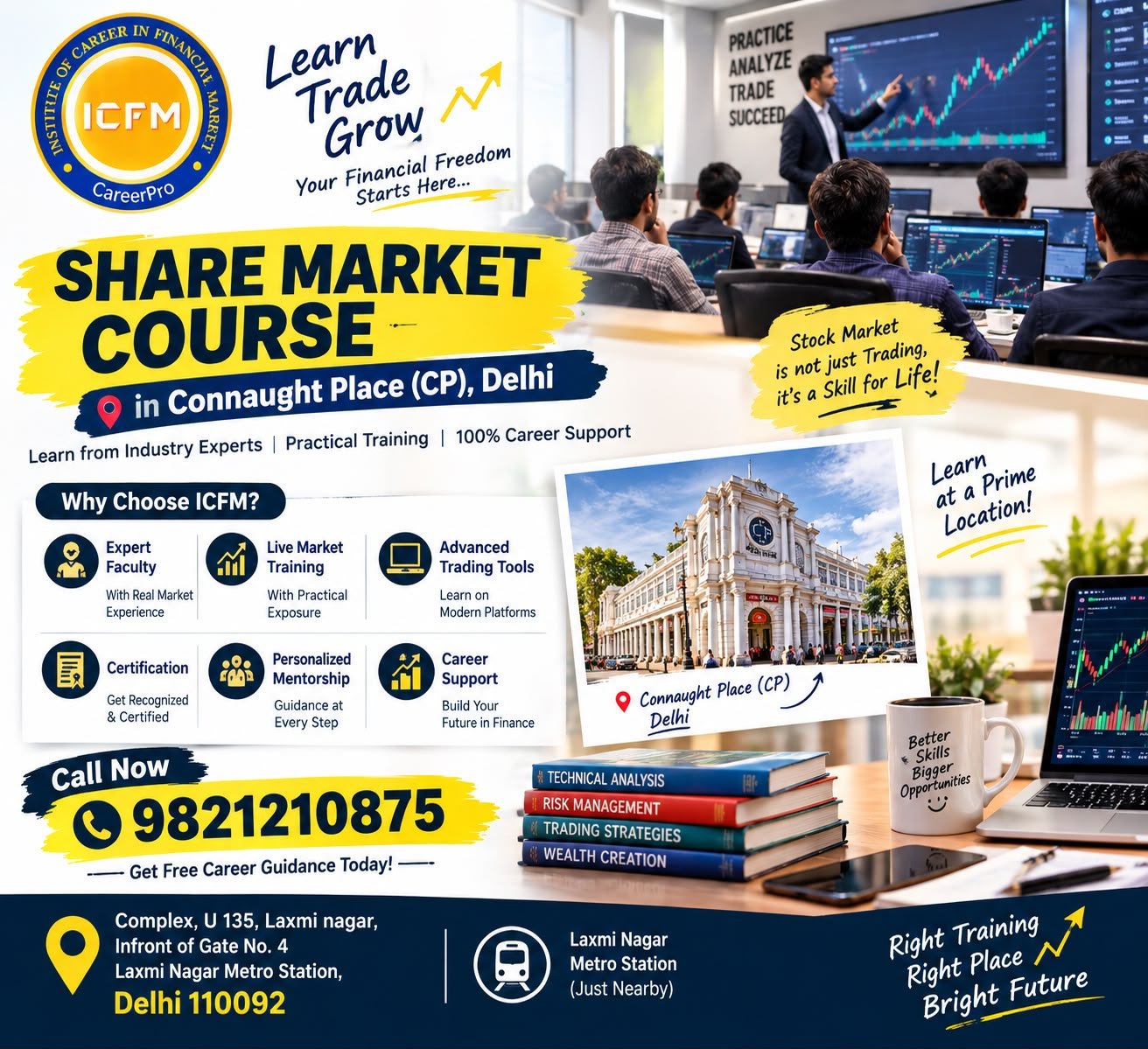
Learn practical trading, investment, technical analysis, fundamental analysis, and risk management with ICFM’s Share Market Course in Connaught Place (CP), Delhi. Build practical market knowledge and develop skills for financial-market careers.
The share market can look simple when viewed from the outside. You open a trading account, search for a stock, place an order and watch the price move. But becoming capable of making informed trading or investment decisions requires much more than knowing how to buy or sell a share.
You need to understand market behaviour, price movements, financial statements, technical indicators, risk management, trading psychology and the discipline required to follow a strategy.
That is where structured education becomes valuable.
If you are searching for a Share Market Course in Connaught Place (CP), ICFM provides practical financial-market training designed to take learners from fundamental concepts to more advanced market analysis. The focus is on developing usable skills rather than simply completing a syllabus.
Whether you are a student exploring a career in finance, a working professional looking to develop a new skill, or someone who wants to understand investing more systematically, the right course can provide a much clearer learning path.
Why Learn the Share Market Professionally?
There is no shortage of stock-market information online. Videos, social-media posts, trading tips, indicators and market opinions are available everywhere.
The problem is not finding information.
The problem is knowing what information matters, how to interpret it, and how to apply it responsibly.
A structured share market course can help you build that foundation.
Instead of learning isolated concepts, you can progress through:
Market Basics → Analysis → Strategy → Risk Management → Practical Application → Career Skills
This approach helps beginners understand not only what happens in the market, but also why prices, trends and investor behaviour matter.
What Makes a Good Share Market Course?
Before choosing any institute, learners should look beyond advertising claims and evaluate the actual learning experience.
A useful program should provide:
1. Strong Market Fundamentals
You should first understand the foundation of the financial markets, including:
- Equity markets
- Stock exchanges
- Market participants
- Primary and secondary markets
- Trading and investment concepts
- Order types
- Market terminology
- Demat and trading account concepts
A strong foundation makes advanced topics easier to understand.
2. Technical Analysis
Technical analysis helps traders study price and volume data to identify market patterns and potential trading setups.
Training may include:
- Candlestick analysis
- Support and resistance
- Trend identification
- Chart patterns
- Moving averages
- Momentum indicators
- Volume analysis
- Breakouts and breakdowns
- Price action
- Multiple-timeframe analysis
The objective should not be to memorise indicators. It should be to understand how different technical tools can be interpreted within a broader market context.
Fundamental Analysis: Understanding the Business Behind the Stock
Trading and investing are not the same activity.
While traders may focus heavily on price behaviour and market momentum, investors often need to understand the underlying business.
A comprehensive share market course should therefore introduce learners to fundamental analysis.
Topics can include:
- Balance sheet
- Profit and loss statement
- Cash-flow statement
- Revenue and profitability
- Earnings growth
- Debt levels
- Valuation concepts
- Industry comparison
- Sector analysis
- Economic factors
This gives learners another perspective when evaluating companies for longer-term investment decisions.
Trading Without Risk Management Is Incomplete
One of the most important areas of market education is often overlooked by beginners: risk management.
Knowing how to identify a trade is only one part of the process.
You also need to understand how much capital you are willing to risk and how a single unsuccessful position can affect your overall trading plan.
ICFM's training approach can introduce learners to concepts such as:
- Position sizing
- Stop-loss planning
- Risk-to-reward concepts
- Capital allocation
- Diversification
- Trade planning
- Drawdown management
- Trading discipline
The purpose of risk management is not to eliminate losses. No legitimate market education can promise that.
The objective is to help learners understand and control risk more systematically.
Practical Learning: Turning Concepts into Skills
Reading about candlestick patterns is different from interpreting a live chart.
Understanding a balance sheet is different from comparing two companies.
Knowing what a stop-loss is is different from actually planning risk before entering a trade.
That is why practical exposure is an important component of financial-market education.
ICFM's current course portfolio includes practical-oriented offerings such as live Indian-market training, technical-analysis live trading, options analysis and equity trading courses.
A practical learning environment can help students develop the habit of:
Observe → Analyse → Plan → Execute → Review
This process is more valuable than simply memorising definitions for an examination.
Learn How Professional Traders Think
Successful market participation is not only about charts and numbers.
Psychology also plays an important role.
New traders commonly struggle with:
- Fear after a loss
- Overconfidence after a profit
- Revenge trading
- Overtrading
- Entering without a plan
- Ignoring stop-loss levels
- Following rumours
- Changing strategies too frequently
A good educational program should help learners recognise these behavioural challenges and develop a more disciplined approach.
The goal is to replace impulsive decisions with a defined process.
Trading Tools You Should Become Comfortable With
Modern market participants use technology extensively.
During structured market training, learners can become familiar with tools used for chart analysis, market observation and order execution.
Depending on the program, this can include:
TradingView
For charting, technical analysis and market observation.
NSE/BSE Market Information
For understanding listed securities and market data.
Screeners and Scanners
For filtering stocks according to selected conditions.
Trading Platforms
For understanding order placement and execution.
The important point is not simply learning where to click.
It is learning why and when a particular tool is useful.
Share Market Course in Connaught Place (CP): Who Can Join?
A professional share market course can be useful for different types of learners.
Students
Students interested in finance can use structured training to develop practical market knowledge alongside their academic education.
Working Professionals
Professionals can learn market concepts as an additional financial skill or explore a transition toward financial-market roles.
Beginners
People with no previous trading experience can start with fundamentals before progressing to advanced concepts.
Existing Traders
Those already participating in the market can use structured learning to identify gaps in their knowledge and improve their approach.
Investors
Long-term investors can learn how to analyse companies, sectors and financial information more systematically.
Career Aspirants
Learners interested in equity dealing, research, trading support, investment operations or related financial roles can develop relevant foundational skills.
Prior stock-market experience is not necessarily required for beginner-level learning.
From Learning the Market to Building a Finance Career
A share market course can serve two different purposes.
For some learners, it is about developing personal market knowledge.
For others, it can become the starting point for a professional career.
Depending on qualifications, experience and role requirements, financial-market knowledge can support career paths such as:
- Equity Dealer
- Trading Executive
- Research Support Executive
- Technical Analysis Professional
- Investment Operations Executive
- Client Relationship Executive
- Market Research Associate
- Portfolio Support Executive
- Financial Market Trainer
- Independent Trader or Investor
A course does not automatically guarantee employment or trading success. Career outcomes depend on the learner's skills, qualifications, experience, performance and the requirements of individual employers.
That distinction is important when selecting a genuine financial-market education provider.
Why ICFM Focuses on Career-Oriented Financial Education
ICFM – Institute of Career in Financial Market focuses on financial-market education across areas including equity trading, technical analysis, derivatives, options, fundamental analysis, swing trading, intraday trading and professional trading programs.
Its existing Connaught Place-focused course content also highlights practical market exposure, technical and fundamental analysis, trading strategies, risk management, trading platforms and career preparation.
The broader objective is to help learners understand the market as a professional discipline rather than treating trading as a shortcut to quick profits.
A Better Way to Approach Your First Stock Market Course
If you are completely new to the share market, do not begin by asking:
“Which stock should I buy?”
Begin with better questions:
How does the market work?
How do I analyse a company?
How do I read a chart?
How do I define risk before entering a position?
How do I create and test a trading plan?
How do professional market participants make decisions?
These questions create a much stronger foundation.
A good share market course should help you answer them step by step.
Why Connaught Place (CP) Works Well for Finance Learning
Connaught Place is one of central Delhi's major commercial areas, with offices, financial businesses, professional services and strong metro connectivity.
For learners who work or study in central Delhi, choosing a training location around CP can make regular classroom participation more convenient.
At the same time, learners should focus on the quality of training, curriculum, practical exposure and instructor expertise rather than choosing an institute only because of its location.
Location can make learning convenient.
Quality makes learning valuable.
What You Should Expect From Your Learning Journey
A serious learner should expect the course to involve both knowledge and practice.
Your learning journey can broadly progress through five stages:
Stage 1 — Understand
Learn the language and structure of the market.
Stage 2 — Analyse
Study charts, companies, sectors and market behaviour.
Stage 3 — Plan
Develop entry, exit and risk-management frameworks.
Stage 4 — Practise
Apply concepts to real-market examples and practical exercises.
Stage 5 — Review
Evaluate decisions, identify mistakes and improve your process.
This approach encourages continuous learning instead of dependence on random market tips.
Common Mistakes Beginners Should Avoid
Before entering the market, new learners should be aware of several common mistakes:
Following social-media tips blindly
A stock recommendation without proper analysis may not suit your financial objectives or risk tolerance.
Trading without a plan
Entering a position without defining risk and exit conditions can lead to emotional decisions.
Using too much leverage
Leverage can magnify both gains and losses and should be understood carefully.
Expecting guaranteed returns
No genuine course can guarantee profits from stock-market trading.
Ignoring losses
Losses are part of market participation. The focus should be on risk control and consistency.
Changing strategies constantly
A disciplined learning process requires time, practice and review.
Why Practical Financial Education Matters
The share market rewards knowledge, discipline and continuous learning—but it does not provide guaranteed outcomes.
The purpose of professional training should therefore be to build decision-making ability, not unrealistic expectations.
At ICFM, learners can explore different areas of financial-market education and develop a structured understanding of trading and investment concepts.
For someone searching for a Share Market Course in Connaught Place (CP), the right starting point is not a promise of instant profits.
It is a clear learning framework.
Start Your Share Market Learning Journey with ICFM
If your objective is to understand equity markets, develop trading and investment knowledge, learn technical and fundamental analysis, and explore professional opportunities in financial markets, a structured course can give you a strong starting point.
ICFM provides financial-market education with practical and career-oriented learning options for beginners, traders, investors and finance aspirants.
ICFM – Institute of Career in Financial Market
Address: Complex, U 135, Laxmi Nagar, In front of Gate No 4, Laxmi Nagar Metro Station, Delhi 110092
Email: info@icfmindia.in
Phone: +91 9821210875
Website: www.icfmindia.in
Course Information: www.icfmindia.in/organic-stock-market-course
Build Knowledge Before You Build a Trading Strategy
The first step in the stock market should not be chasing a tip.
It should be learning how the market works.
Learn the fundamentals. Understand the analysis. Practise the process. Manage risk. Keep improving.
That is the foundation of responsible participation in the financial markets.

ICFM Admin
Senior Trading Analyst at ICFM India
Rahul Rai is a certified market professional with over 12 years of experience in equity and derivatives trading. He specializes in technical analysis and margin trading strategies, and has trained over 5,000 students through ICFM India's certification programs.

