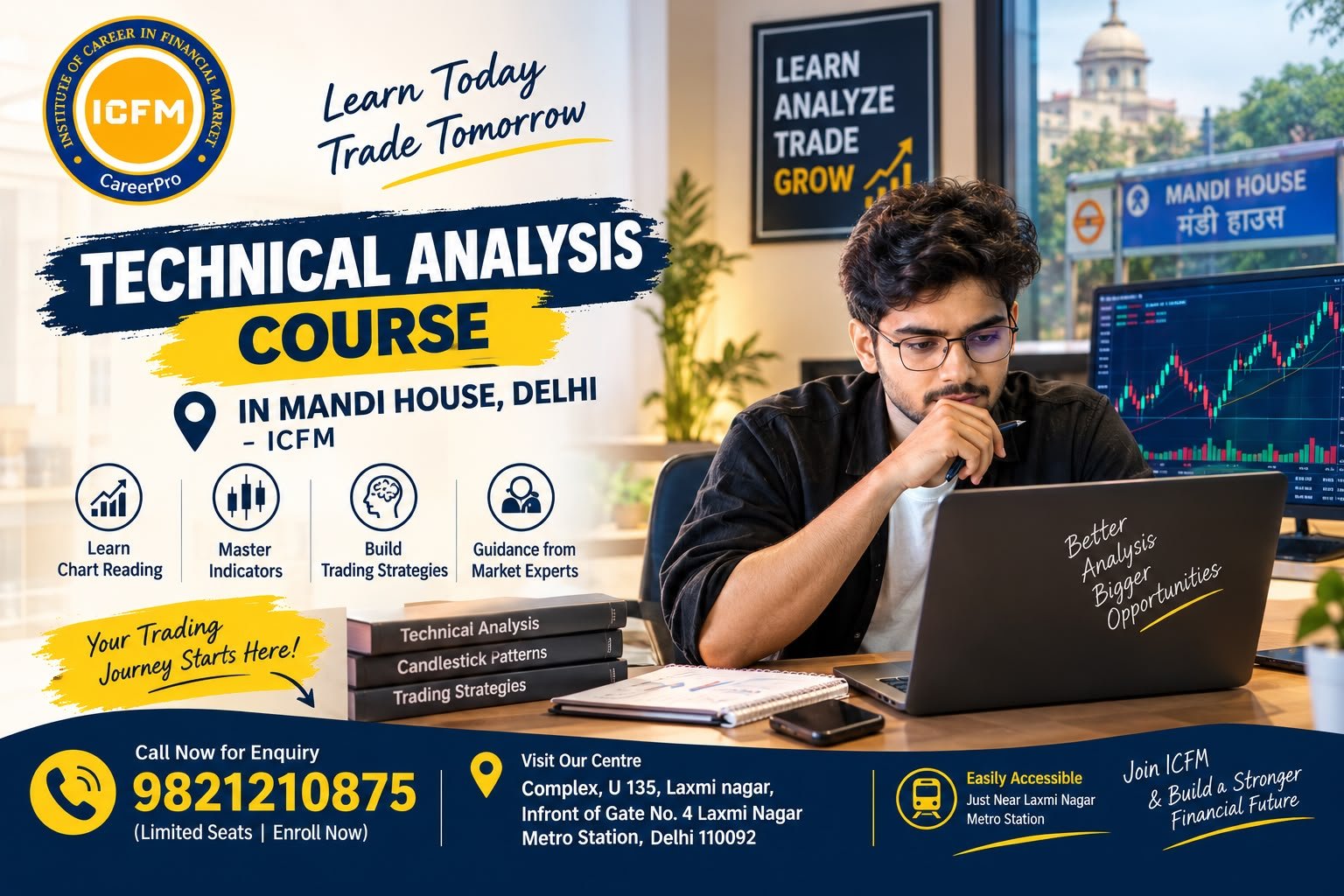

Join ICFM's Trading Classes in Daryaganj to learn stock market fundamentals, technical analysis, candlestick patterns, trading strategies, investment concepts, and risk management through structured practical training. Explore professional stock market education with classroom and online learning options.
Choosing the right trading education is an important first step for anyone who wants to understand the financial markets. Whether you are a beginner exploring the stock market for the first time or someone who wants to improve existing trading knowledge, professional guidance can help you develop a structured approach to learning.
If you are searching for Trading Classes in Daryaganj, ICFM – Institute of Career in Financial Market offers practical stock market education designed to develop market understanding, analytical abilities, and essential trading skills. The learning approach focuses on understanding how markets function, interpreting price movements, studying financial instruments, and applying appropriate risk management techniques.
Instead of learning isolated trading tips or depending on unverified market calls, students are encouraged to understand the logic behind market movements. This creates a stronger foundation for making informed trading and investment decisions.
1. Why Learning Trading Requires More Than Basic Market Knowledge
Many people enter the stock market after watching online videos, following social media discussions, or receiving suggestions from friends. Although these resources may introduce basic concepts, they do not always provide a systematic understanding of trading.
Successful market participation requires knowledge of several interconnected areas:
Understanding stock exchanges and market operations.
Reading price charts and identifying market trends.
Studying candlestick patterns and price action.
Understanding technical indicators and trading volumes.
Learning fundamental analysis and company evaluation.
Managing capital and controlling potential losses.
Developing discipline and emotional awareness.
Professional trading classes in Daryaganj can help learners understand these subjects through a structured educational process. The objective is to build independent analytical thinking instead of encouraging blind dependence on trading recommendations.
2. What Makes ICFM's Trading Education Different?
ICFM – Institute of Career in Financial Market focuses on providing financial market education through a combination of conceptual learning and practical exposure.
The institute's learning approach is built around an important principle: students should understand why a trading decision is considered, how market information is interpreted, and what risks may be involved.
The training emphasizes:
Concept-Based Education: Students begin with essential stock market concepts before progressing towards advanced subjects.
Practical Market Understanding: Learners study real market movements, price behaviour, chart structures, and trading examples.
Analytical Development: The curriculum introduces technical and fundamental analysis to help students evaluate market opportunities.
Risk Awareness: Students learn about stop-loss planning, position sizing, capital allocation, and trading discipline.
Career-Oriented Learning: Those interested in finance-related employment can develop foundational knowledge relevant to different financial market roles.
ICFM aims to make financial education understandable, structured, and relevant to real-world market participation.
3. Understanding the Complete Trading Curriculum
A quality trading education should cover more than buying and selling shares. At ICFM, learners can explore important financial market subjects through a progressive learning structure.
Module 1: Introduction to the Stock Market
The first stage introduces students to the financial market ecosystem.
Topics include:
Meaning and purpose of the stock market.
Primary and secondary markets.
NSE and BSE introduction.
Equity market fundamentals.
Market participants and their responsibilities.
Demat and trading accounts.
Market orders and order execution.
Basic understanding of indices such as Nifty and Sensex.
This foundation helps beginners understand the environment in which trading and investing take place.
Module 2: Technical Analysis and Chart Reading
Technical analysis is an important part of trading education because it helps learners study historical price behaviour and market trends.
Students explore:
Japanese candlestick charts.
Different chart patterns.
Support and resistance levels.
Trendlines and price channels.
Moving averages.
RSI and MACD indicators.
Volume analysis.
Breakout and breakdown concepts.
Price action techniques.
Intraday and swing trading concepts.
The objective is to understand how technical tools work and how they can be used to evaluate potential trading situations.
Module 3: Fundamental Analysis and Investment Understanding
Trading education becomes more comprehensive when students also understand the financial condition of businesses.
This section introduces:
Balance sheets.
Profit and loss statements.
Cash flow statements.
Revenue and profitability.
Earnings per share.
Price-to-earnings ratio.
Company valuation basics.
Sector comparison.
Economic factors affecting markets.
Long-term investment principles.
These subjects help learners distinguish between short-term market movements and the underlying financial performance of companies.
Module 4: Derivatives and Advanced Market Concepts
As students progress, they can explore important concepts associated with derivatives markets.
Topics may include:
Futures and options introduction.
Call and put options.
Option premiums.
Expiry and strike prices.
Open interest.
Basic option-chain interpretation.
Hedging concepts.
Derivatives-related risk.
The emphasis should remain on understanding the mechanics and risks of these instruments before considering their practical application.
Module 5: Trading Platforms and Research Tools
Modern traders use digital platforms to study financial information and analyse market behaviour.
Students become familiar with tools and platforms such as:
TradingView charting tools.
NSE market information.
BSE market resources.
Technical indicators.
Stock screeners.
Market watchlists.
Chart-based research.
Order types and execution concepts.
Understanding these tools helps learners become more comfortable with the technology used in financial markets.
Module 6: Risk Management and Trading Psychology
One of the most important aspects of trading is understanding risk.
Students learn about:
Capital management.
Stop-loss planning.
Risk-to-reward ratios.
Position sizing.
Diversification.
Trading discipline.
Emotional decision-making.
Avoiding overtrading.
Maintaining a trading journal.
A sound trading approach must consider the possibility of losses. No strategy or technical indicator can guarantee profits.
4. Why Daryaganj Learners Should Consider Professional Trading Education
Daryaganj is an established locality in central Delhi, with access to educational, commercial, and professional activities.
Students, graduates, working professionals, and individuals interested in financial markets may want to develop additional skills alongside their existing education or employment.
For learners exploring trading classes in Daryaganj, choosing an institute with a structured curriculum can make the learning process more organised.
ICFM provides an opportunity to explore financial market education through classroom-oriented and online learning options, subject to course availability.
Learners can develop their understanding of stock market operations without treating trading as a shortcut to immediate income.
5. Trading Education for Beginners and Experienced Learners
Different students enter the stock market with different expectations. A well-organised learning programme should accommodate different knowledge levels.
For Beginners
People with no previous market experience can start with basic concepts, terminology, exchanges, trading accounts, and chart reading.
For College Students
Students interested in finance, commerce, economics, or business can explore financial market concepts as an additional professional skill.
For Working Professionals
Individuals looking to expand their knowledge can study trading, investment analysis, and market research alongside their existing responsibilities.
For Aspiring Traders
Learners who already follow the stock market can improve their understanding of technical analysis, risk management, and structured trading methods.
For Investors
People interested in long-term wealth creation can explore company analysis, financial statements, valuation basics, and portfolio concepts.
6. Career Possibilities After Learning Stock Market Trading
Financial market education can help learners build knowledge relevant to several professional opportunities.
Depending on qualifications, experience, applicable regulatory requirements, and additional training, potential career directions include:
Equity Dealer.
Stock Market Research Assistant.
Financial Market Executive.
Trading Desk Support Executive.
Investment Operations Associate.
Client Relationship Executive.
Financial Research Assistant.
Broking Operations Professional.
Market Education Professional.
Students interested in becoming independent traders or investors can also use their education to develop a more disciplined approach to analysing financial markets.
It is important to understand that completing a course does not automatically guarantee employment, professional licensing, or trading income. Career outcomes depend on individual skills, qualifications, performance, and market opportunities.
7. How to Select the Right Trading Institute in Delhi
Before enrolling in any stock market training programme, learners should evaluate the quality of education rather than choosing an institute only because of attractive advertisements.
Consider the following factors:
Curriculum: Does the programme cover basic and advanced market concepts?
Faculty: Do trainers have relevant financial market knowledge and teaching experience?
Practical Learning: Are real market examples and chart-based exercises included?
Risk Management: Does the course explain the risks associated with trading?
Learning Support: Can students ask questions and clarify difficult concepts?
Career Guidance: Does the institute provide suitable career guidance and placement assistance?
Fee Transparency: Are course fees, duration, and other charges explained clearly?
Certification Details: Are the issuing authority and recognition claims clearly disclosed?
These checks can help students make an informed decision about their financial education.
8. Why Consider ICFM – Institute of Career in Financial Market?
ICFM is focused on stock market and financial market education. Its training approach aims to connect fundamental knowledge with practical market understanding.
The institute emphasises:
Structured stock market learning.
Technical analysis education.
Fundamental analysis concepts.
Understanding of equity and derivatives.
Market-related tools and platforms.
Risk management awareness.
Practical examples and chart interpretation.
Guidance for finance-related career development.
For anyone searching for Trading Classes in Daryaganj, ICFM offers an opportunity to explore a more organised way of learning the stock market.
Prospective students are encouraged to understand the course syllabus, available batches, fees, certification details, and learning format before admission.
9. Frequently Asked Questions About Trading Classes in Daryaganj
Q1. Can beginners join trading classes at ICFM?
Yes. Beginners can start by learning stock market fundamentals, trading terminology, market operations, and basic chart analysis. Previous trading experience is not essential for introductory learning.
Q2. What subjects are covered in trading classes?
The learning areas may include stock market fundamentals, technical analysis, candlestick patterns, fundamental analysis, derivatives, trading platforms, and risk management.
Q3. Can I learn intraday trading?
Students can study intraday trading concepts, chart patterns, price movements, technical indicators, and risk management. Actual trading involves financial risk and requires independent preparation.
Q4. Are online learning options available?
ICFM offers online and classroom-oriented learning options, depending on the programme and batch availability. Contact the admissions team for current details.
Q5. Can trading education help me get a finance job?
It can help develop relevant financial market knowledge. Employment also depends on academic qualifications, practical abilities, interview performance, and the requirements of the employer.
Q6. Do I need a commerce background to learn trading?
No. People from different academic backgrounds can begin with introductory stock market education and gradually develop their knowledge.
Q7. How do I find out about course fees and admission?
You can contact ICFM directly through its official website or admissions helpline to request updated information about course fees, schedules, and available programmes.
10. Begin Your Stock Market Learning Journey with ICFM
Learning the stock market is a process that requires patience, practice, analytical thinking, and continuous improvement. Whether your objective is to understand equity trading, explore investment opportunities, develop technical analysis skills, or prepare for a finance-related career, the right educational foundation can make a meaningful difference.
If you are exploring Trading Classes in Daryaganj, connect with ICFM – Institute of Career in Financial Market to understand the available programmes and identify a suitable learning pathway.
Contact ICFM – Institute of Career in Financial Market
Institute: ICFM – Institute of Career in Financial Market
Training Centre Address: Complex, U 135, Laxmi Nagar, In front of Gate No. 4, Laxmi Nagar Metro Station, Delhi – 110092.
Email: info@icfmindia.in
Phone: +91 9821210875
Official Website: https://icfmindia.in/
Stock Market Course: https://icfmindia.in/organic-stock-market-course
Location Reference: Daryaganj, Delhi
Take the First Step Towards Better Financial Market Knowledge
Explore professional stock market education, understand trading concepts, and develop the analytical skills needed to navigate financial markets more confidently.
ICFM – Learn the Market. Understand the Strategy. Build Your Skills.

ICFM Admin
Senior Trading Analyst at ICFM India
Rahul Rai is a certified market professional with over 12 years of experience in equity and derivatives trading. He specializes in technical analysis and margin trading strategies, and has trained over 5,000 students through ICFM India's certification programs.