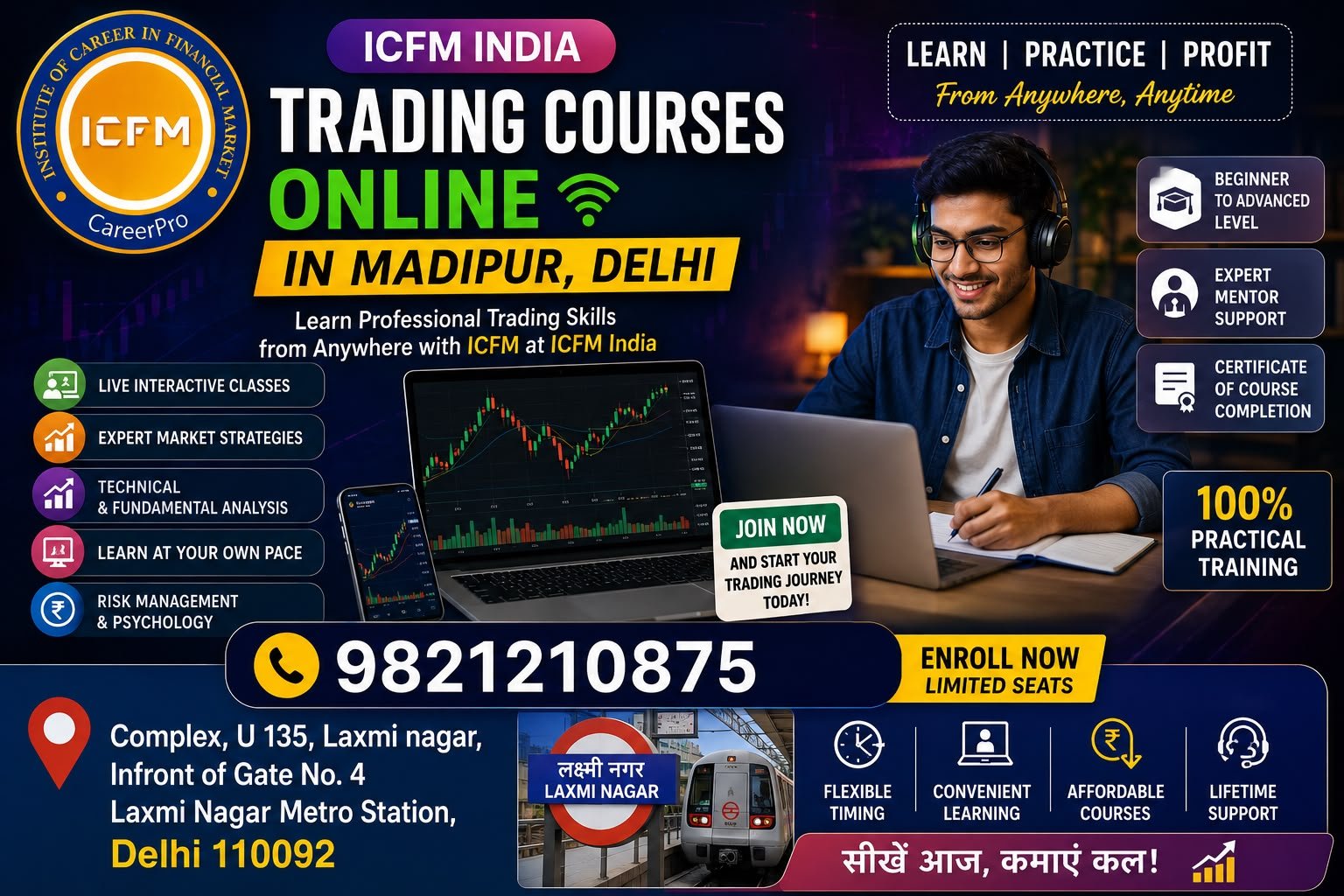
Learn professional trading from anywhere with ICFM’s Trading Courses Online in Madipur. Build practical knowledge of stock markets, technical analysis, fundamental analysis, trading strategies, risk management, and market psychology through structured online training. Ideal for beginners, students, working professionals, investors, and aspiring traders looking to develop career-focused financial market skills with expert guidance.
Learning the stock market does not always require travelling to a classroom every day. For students, working professionals, entrepreneurs, and aspiring traders in Madipur, trading courses online in Madipur can provide a flexible way to develop financial-market knowledge while continuing with existing responsibilities.
However, choosing an online trading course should not be based simply on recorded videos, attractive advertisements, or promises of quick profits. A serious learner needs structured education, practical market understanding, technical and fundamental analysis, risk-management knowledge, experienced guidance, and opportunities to apply concepts in real market situations.
ICFM – Institute of Career in Financial Market approaches online financial education with this practical philosophy. Its e-learning platform supports online and hybrid learning, including live interaction and access to recorded classes, while its course portfolio covers areas such as equity trading, technical analysis, derivatives, professional trading, international markets, and algorithmic trading.
For learners searching for trading courses online in Madipur, the objective should be simple: learn how markets work, understand why prices move, develop analytical skills, manage risk responsibly, and build knowledge that can support either a professional finance career or a more informed approach to personal investing.
Why Online Trading Education Is Becoming Important
The financial market is no longer something only professional brokers or large financial institutions can access. Individuals can now follow market information, analyse securities, and place orders through digital platforms.
But accessibility does not automatically mean expertise.
Having a demat account and trading application is easy. Understanding what to trade, when to trade, how much capital to risk, and when not to trade requires education and discipline.
A well-designed online trading course can help learners understand:
- Stock market fundamentals
- Equity and derivatives
- Market participants and exchanges
- Candlestick charts
- Technical indicators
- Price action
- Support and resistance
- Market trends
- Trading strategies
- Fundamental analysis
- Risk management
- Position sizing
- Trading psychology
- Order execution
- Market research
- Portfolio concepts
The purpose is not to predict every market movement. The purpose is to develop a repeatable analytical process.
Why Choose Trading Courses Online in Madipur?
Online education offers a different learning experience from traditional classroom-only training.
Learn Without Daily Travel
Learners from Madipur can attend classes from home, office, college, or another convenient location. This can be particularly useful for professionals and students whose schedules make daily commuting difficult.
Flexible Learning
Online learning can make it easier to balance financial-market education with work, college, business, or other commitments.
Learn from Market-Oriented Faculty
The quality of an online course depends heavily on the instructor and curriculum. ICFM's e-learning model is designed to provide faculty interaction and support rather than treating online education as a collection of disconnected videos.
Combine Learning With Practice
Trading is a practical subject. Reading about support and resistance is different from observing price movement and understanding how those levels behave in a live market environment.
ICFM highlights practical training and live-market learning as important components of its financial-market education.
What Should You Learn in an Online Trading Course?
A quality trading program should take learners through a logical progression instead of immediately presenting complicated strategies.
1. Understand the Stock Market Foundation
The first stage should answer basic questions:
- What is the stock market?
- How do stock exchanges operate?
- What are NSE and BSE?
- What is a demat account?
- What is a trading account?
- What are market and limit orders?
- How does order execution work?
- What affects share prices?
This foundation is particularly important for beginners because advanced strategies become difficult to understand without basic market knowledge.
2. Develop Technical Analysis Skills
Technical analysis is an important component of many trading approaches.
Students can learn how to interpret:
- Candlestick formations
- Price action
- Trends
- Trendlines
- Support and resistance
- Volume
- Breakouts
- Moving averages
- Momentum indicators
- Oscillators
- Chart patterns
The goal should not be to memorise dozens of indicators.
Instead, learners should understand how different pieces of market information can be combined into a structured analysis.
3. Learn Fundamental Analysis
Trading education should not completely ignore the investment side of financial markets.
Fundamental analysis helps learners understand a company's financial and business position through areas such as:
- Revenue
- Profitability
- Balance sheet
- Cash flow
- Earnings
- Valuation
- Sector performance
- Industry trends
- Economic factors
This knowledge can be particularly useful for individuals interested in investing, research, equity analysis, and longer-term market decisions.
4. Understand Different Trading Styles
Every market participant has different objectives, time availability, and risk tolerance.
An effective course can introduce learners to different approaches, including:
Intraday Trading
Understanding short-term price movements and market-session behaviour.
Swing Trading
Learning how traders attempt to capture price movements over several sessions or weeks.
Positional Trading
Understanding trades based on broader market trends and longer holding periods.
Derivatives Trading
Learning the fundamentals of futures and options, including their structure, risks, and applications.
ICFM currently lists dedicated programs covering equity trading, swing trading, derivatives, professional trading, and other specialised areas.
Risk Management: The Part Every Trader Needs to Understand
One of the biggest mistakes beginners make is focusing entirely on potential returns.
Professional market education should give equal or greater importance to risk.
Students should understand concepts such as:
- Stop-loss planning
- Position sizing
- Capital allocation
- Risk-to-reward concepts
- Diversification
- Drawdown
- Trade planning
- Emotional discipline
No course can eliminate market risk, and no legitimate education should promise guaranteed trading profits.
The objective of training is to help learners make better-informed and more disciplined decisions.
Trading Psychology Matters
A trading strategy can look excellent on paper and still fail if the trader cannot follow it consistently.
Emotions such as:
- Fear
- Greed
- Revenge trading
- Overconfidence
- Impatience
- Fear of missing out
can influence decision-making.
A professional trading course should therefore discuss trading psychology alongside technical skills.
The best trader is not necessarily the person who makes the most predictions. It is often the person who can follow a defined process, manage risk, accept losses, and avoid impulsive decisions.
How ICFM Approaches Online Trading Education
ICFM's online learning platform is designed around a hybrid approach that allows learners to participate remotely while retaining interaction with faculty. The institute states that its online programs include direct faculty support, recorded classes, practical training, and access to trading-related infrastructure and tools.
Its course portfolio includes programs such as:
- Certificate in Equity Trading
- Certified Technical Analyst
- Certified Derivatives Trader
- Certified Professional Trader
- Certified Algo Trader
- International Market Trading
- Certified Financial Market Professional
The exact program a learner should choose depends on their background, objectives, experience, and area of interest.
Online Trading Course vs Random YouTube Videos
Free online content can be useful for discovering basic concepts, but it often lacks a systematic learning sequence.
| Learning Factor | Structured Online Course | Random Online Videos |
|---|---|---|
| Curriculum | Systematic | Often fragmented |
| Faculty guidance | Available in structured programs | Usually limited |
| Practical progression | Planned | Inconsistent |
| Doubt solving | Course-dependent support | Limited |
| Risk management | Can be integrated throughout | Often overlooked |
| Career orientation | Possible | Usually absent |
| Certification | Available in relevant programs | Generally unavailable |
The difference is not simply online versus offline.
The real difference is structured education versus unstructured information.
Who Can Join Online Trading Courses in Madipur?
Online trading education can suit a wide range of learners.
College Students
Students interested in finance can begin developing market knowledge alongside their academic studies.
Working Professionals
Professionals can learn without leaving their existing job or travelling to a training centre every day.
Beginners
People with no previous trading experience can start with financial-market fundamentals before progressing toward technical and practical topics.
Existing Traders
Individuals already participating in the market can use structured education to identify gaps in their knowledge.
Investors
Long-term investors can learn fundamental analysis, valuation concepts, portfolio principles, and market behaviour.
Career Switchers
Professionals considering financial-market careers can explore relevant skills before moving into specialised roles.
Can an Online Trading Course Help Build a Career?
It can provide a foundation, but a course should not be presented as an automatic job guarantee.
Financial-market careers generally require a combination of education, practical skills, qualifications, experience, communication ability, and role-specific knowledge.
Depending on their qualifications and experience, learners may explore areas such as:
- Equity Dealer
- Research Assistant
- Research Executive
- Trading Desk Support
- Investment Support Executive
- Financial Market Executive
- Client Relationship Roles
- Portfolio Support
- Technical Analysis
- Fundamental Research
- Independent Trading or Investing
For candidates interested in professional employment, career preparation should extend beyond market concepts to include communication, interview preparation, resume development, and understanding the responsibilities associated with specific financial roles.
What Makes a Good Online Trading Course?
Before enrolling, compare courses carefully.
Look for a Curriculum That Covers More Than Indicators
A strong program should include market fundamentals, analysis, execution, risk management, and psychology.
Check Whether Practical Learning Is Included
Trading is an applied discipline. Practical exposure can help learners understand how concepts behave outside a textbook.
Examine Faculty Experience
The quality of teaching can significantly influence the learning experience.
Ask About Doubt Support
Online students should have a reliable way to clarify questions and revisit difficult concepts.
Understand Certification Details
A certificate can be useful, but learners should understand exactly what the certification represents and what skills the course actually develops.
Avoid Unrealistic Profit Claims
No genuine course can guarantee trading profits. Market outcomes remain uncertain.
A Better Learning Path for Beginners
Instead of trying to learn everything at once, beginners can follow a progressive approach:
Stage 1: Financial-market fundamentals
↓
Stage 2: Equity and market mechanics
↓
Stage 3: Technical analysis
↓
Stage 4: Fundamental analysis
↓
Stage 5: Trading strategies
↓
Stage 6: Risk management
↓
Stage 7: Trading psychology
↓
Stage 8: Practical market application
↓
Stage 9: Advanced or specialised trading
↓
Stage 10: Career development
This approach creates a stronger foundation than jumping directly into complicated strategies.
Why Madipur Learners Can Consider Online Training
Madipur is part of West Delhi's wider residential and commercial ecosystem, with nearby areas including Punjabi Bagh, Paschim Vihar, Peeragarhi, and other established neighbourhoods.
For someone living in Madipur, online learning can remove much of the daily travel involved in attending a distant institute.
More importantly, online learning allows students to build a consistent study routine around their existing schedule.
ICFM's existing online-learning model is specifically designed to allow learners to participate from their preferred location while maintaining interaction with the institute.
Build Knowledge Before You Take Market Risk
The stock market should not be approached as a shortcut to fast money.
It is a professional financial environment where decisions involve uncertainty and risk.
A better approach is to:
Learn → Analyse → Practise → Manage Risk → Review → Improve
This mindset can help beginners avoid many common mistakes.
Trading education cannot predict every market movement. What it can do is help learners understand the tools, concepts, terminology, strategies, and risk-management principles used to analyse markets.
Start Trading Education Online With ICFM
If you are searching for trading courses online in Madipur, ICFM offers a structured route into financial-market education through online and hybrid learning options.
From equity trading and technical analysis to derivatives, professional trading, algorithmic trading, and international markets, ICFM's course portfolio provides multiple pathways for learners with different objectives.
The right course is ultimately the one that matches your current knowledge, career objective, available time, and preferred area of the financial markets.
ICFM – Institute of Career in Financial Market
Address: Complex, U 135, Laxmi Nagar, In Front of Gate No. 4, Laxmi Nagar Metro Station, Delhi – 110092
Phone: +91 9821210875
Email: info@icfmindia.in
Website: icfmindia.in
Trading Courses Online in Madipur – Learn the Market, Build the Skill, Think Professionally
Whether your objective is to understand investing, develop trading skills, prepare for a financial-market career, or simply become more informed about the market, start with education rather than speculation.
Learn the fundamentals. Practise the process. Respect the risk. Build your financial-market knowledge with ICFM.

ICFM Admin
Senior Trading Analyst at ICFM India
Rahul Rai is a certified market professional with over 12 years of experience in equity and derivatives trading. He specializes in technical analysis and margin trading strategies, and has trained over 5,000 students through ICFM India's certification programs.