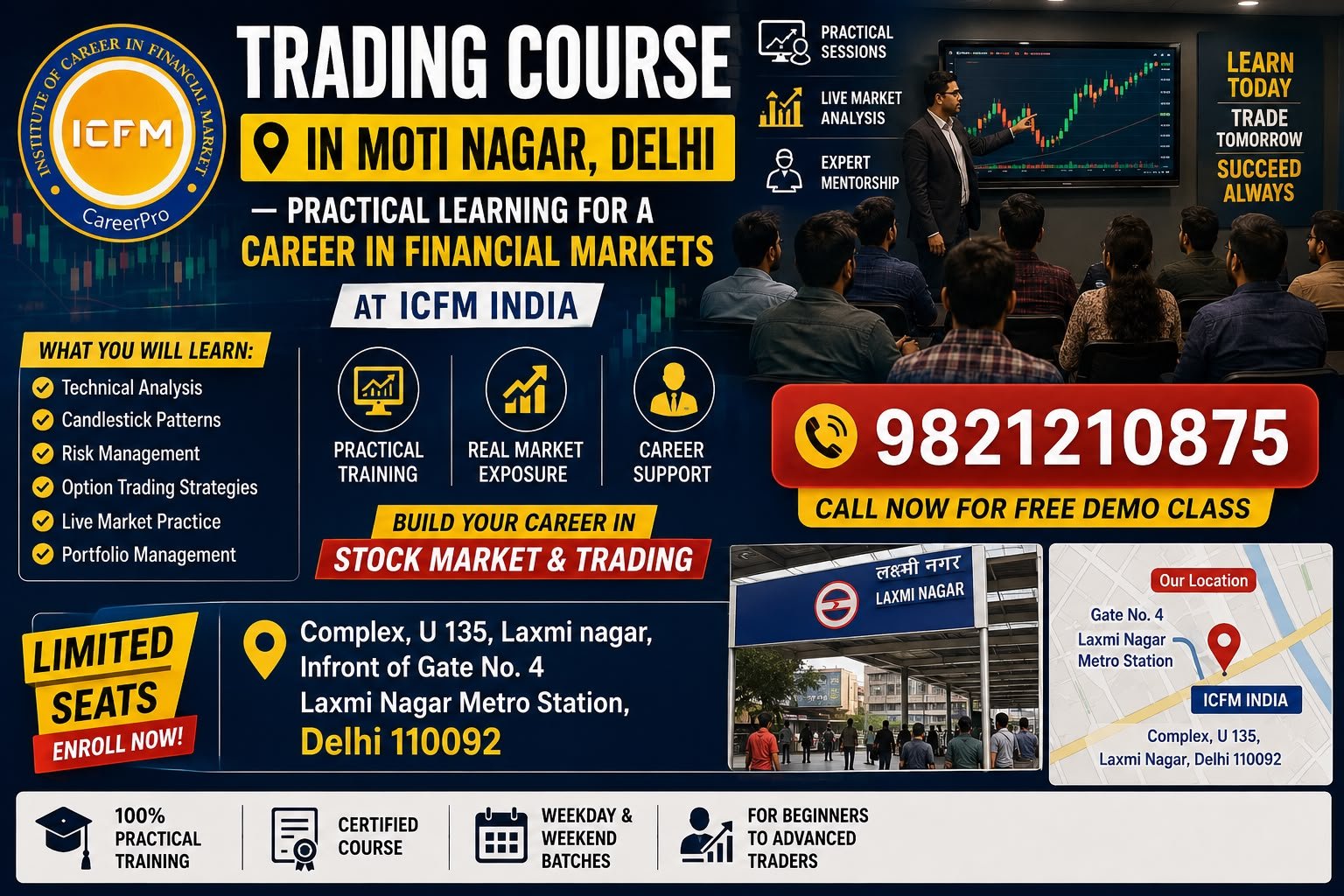
Learn practical trading strategies, technical analysis, risk management, chart reading, and market skills with ICFM’s Trading Course in Moti Nagar. Build a strong foundation for trading and financial-market career opportunities through structured, practical training.
The financial markets are becoming an increasingly important career and skill-development option for students, working professionals, entrepreneurs, and individuals who want to understand how trading and investment actually work. But learning trading successfully requires more than watching random videos, following market tips, or opening a trading account.
If you are searching for a Trading Course in Moti Nagar, ICFM – Institute of Career in Financial Market provides structured financial-market education focused on practical understanding, analytical skills, risk management, and career development.
The objective is simple: help learners understand the market logically, develop a disciplined approach to trading, and build the knowledge required to explore opportunities across the financial-services industry.
A good trading education should not promise quick profits. It should teach you how markets work, how to analyse opportunities, how to manage risk, and how to make informed decisions.
That is the approach ICFM brings to its trading education.
Why Learn Trading Professionally?
Trading looks simple from the outside. A person buys a stock and sells it later. In reality, professional trading involves market structure, technical analysis, capital management, psychology, execution, and continuous decision-making.
Without proper knowledge, beginners can easily make decisions based on emotions, rumours, social-media recommendations, or unrealistic return expectations.
A structured trading course can help you understand:
- How equity markets operate
- How traders analyse price movements
- How charts and indicators are interpreted
- How support and resistance can be identified
- How trends and market structures develop
- How trading strategies are planned
- How stop-loss and position sizing work
- How risk should be managed
- How trading psychology affects decisions
- How professional trading tools are used
The goal is not to predict every market movement. The goal is to develop a repeatable and disciplined decision-making process.
Trading Course in Moti Nagar Designed for Practical Learning
ICFM focuses on combining classroom concepts with practical market-oriented learning.
Instead of limiting education to definitions and textbook concepts, learners are introduced to the way market participants analyse securities and plan trades.
The learning approach covers:
Concept → Analysis → Strategy → Execution → Risk Management → Review
This framework helps students understand not only what a trading concept means, but also when and why it may be used.
What Will You Learn in the Trading Course?
1. Understanding the Financial Markets
Before learning advanced strategies, students need a strong understanding of the market ecosystem.
The foundation includes:
- Stock exchanges and their functions
- Equity and other market instruments
- Market participants
- Trading sessions
- Orders and execution
- Demat and trading account concepts
- Market terminology
- Basic market regulations and practices
A strong foundation makes advanced concepts easier to understand and apply.
2. Technical Analysis
Technical analysis is an important part of short-term and medium-term trading.
The course introduces learners to important concepts such as:
- Price action
- Candlestick patterns
- Trend identification
- Support and resistance
- Chart patterns
- Volume analysis
- Moving averages
- Momentum indicators
- Oscillators
- Breakouts and breakdowns
- Multiple-timeframe analysis
Students learn how different technical signals can be combined rather than depending on a single indicator.
3. Intraday Trading Concepts
Intraday trading requires speed, discipline, and careful risk control.
The course explores:
- Intraday market structure
- Entry and exit planning
- Trade setup identification
- Stop-loss placement
- Risk-to-reward concepts
- Position sizing
- Trade management
- Market volatility
- Pre-market preparation
- Post-trade analysis
The emphasis remains on process and risk awareness rather than unrealistic profit promises.
4. Swing Trading Strategies
Not every trader wants to sit in front of the market throughout the day.
Swing trading can be useful for learners interested in holding positions for several trading sessions based on technical or market analysis.
The curriculum covers:
- Trend-based setups
- Breakout opportunities
- Pullback concepts
- Support and resistance zones
- Volume confirmation
- Entry planning
- Exit planning
- Risk management
- Trade journaling
Students can understand how short-term trading strategies differ from long-term investment approaches.
5. Fundamental Analysis for Better Decisions
Trading education becomes stronger when learners also understand the business behind a stock.
Fundamental analysis introduces:
- Revenue and profit
- Balance sheet
- Cash flow
- Earnings
- Business models
- Industry analysis
- Sector trends
- Valuation concepts
- Economic factors
This knowledge can help learners develop a broader perspective instead of looking only at price charts.
6. Trading Platforms and Market Tools
Modern traders use technology to analyse markets, monitor securities, and execute orders.
Learners can gain exposure to commonly used market-analysis tools and platforms, including:
- TradingView
- Market screeners
- Charting tools
- NSE-related market resources
- Financial-data platforms
- Watchlists
- Technical-analysis tools
The focus is on understanding how these tools support analysis and decision-making.
7. Risk Management: The Most Important Trading Skill
Many beginners focus almost entirely on finding profitable trades. Professional market education must also teach learners how to protect capital.
Risk-management concepts include:
- Stop-loss planning
- Position sizing
- Capital allocation
- Risk-to-reward ratios
- Portfolio diversification
- Maximum-loss planning
- Trading discipline
- Avoiding overtrading
- Managing consecutive losses
A strategy is incomplete if it does not include risk management.
8. Trading Psychology and Discipline
Market knowledge alone does not guarantee disciplined behaviour.
Fear, greed, impatience, overconfidence, and revenge trading can influence decision-making.
ICFM introduces learners to the psychological side of trading, including:
- Emotional discipline
- Following a trading plan
- Handling losses
- Avoiding impulsive decisions
- Maintaining a trading journal
- Reviewing performance
- Building consistency
The objective is to help learners approach markets with a structured mindset.
From Beginner to Confident Market Learner
A major advantage of structured education is that beginners do not have to learn everything randomly.
The learning journey can progress from:
Market Basics → Chart Reading → Technical Analysis → Strategy Development → Risk Management → Practical Analysis → Trade Review
This progression makes the learning experience easier to follow and helps students build knowledge step by step.
Why Choose ICFM for a Trading Course in Moti Nagar?
ICFM – Institute of Career in Financial Market focuses on financial-market education with an emphasis on practical knowledge and career development.
Practical Market Orientation
Learners are introduced to market concepts through practical examples and market-oriented exercises.
Structured Curriculum
The curriculum progresses from fundamental concepts to advanced areas of trading and investment.
Technical and Fundamental Learning
Students get exposure to both chart-based analysis and business-oriented fundamental analysis.
Career Preparation
For learners interested in entering the financial-services industry, the program can provide guidance related to professional roles, interview preparation, and industry expectations.
Experienced Guidance
Learners receive guidance designed to help them understand market concepts clearly and develop analytical thinking.
Flexible Learning
Depending on the available batch, learners can explore classroom and online learning options.
Trading Course in Moti Nagar for Different Learner Profiles
You do not need to be a finance graduate to begin learning about financial markets.
The course can be relevant for:
College Students
Students interested in finance, stock markets, banking, investment, or financial-services careers can build practical knowledge alongside their academic education.
Working Professionals
Professionals can develop financial-market skills as part of their career development or personal learning goals.
Beginners
Those with little or no previous market experience can start with foundational concepts before progressing toward technical analysis and trading strategies.
Aspiring Traders
Individuals who want to explore trading more seriously can learn how to build a structured approach instead of relying on tips or speculation.
Investors
Long-term investors can benefit from understanding company analysis, market behaviour, valuation concepts, and risk management.
Career Switchers
People considering a transition into broking, research, investment support, or other financial-market roles can use structured training to develop relevant knowledge.
Career Opportunities After a Trading Course
Trading education can open the door to multiple areas of the financial-services industry. Depending on qualifications, skills, experience, and applicable regulatory requirements, learners may explore roles such as:
- Equity Dealer
- Trading Desk Executive
- Research Executive
- Market Analyst
- Investment Support Executive
- Client Relationship Executive
- Portfolio Support Executive
- Financial Market Operations Executive
- Business Development Executive in Financial Services
- Independent Trader or Investor
A course is a starting point—not a guarantee of employment or trading profits. Career growth depends on individual skills, performance, experience, qualifications, and market conditions.
What Makes a Good Trading Course Different?
Before choosing any institute, learners should ask important questions:
Does the course teach practical analysis?
Does it explain risk management?
Is the curriculum structured?
Does it teach both market concepts and practical tools?
Are students encouraged to analyse markets independently?
Does the institute provide career guidance?
These questions are more important than simply comparing course fees or promotional claims.
At ICFM, the focus is on building knowledge that learners can continue developing after completing their training.
A Smarter Approach to Learning Trading
There is no shortcut to becoming a skilled market participant.
Successful learning requires:
Knowledge + Practice + Discipline + Risk Management + Continuous Improvement
Learners should understand that financial markets involve risk, and no strategy can guarantee profits. A professional course should therefore focus on education, analysis, decision-making, and responsible risk management.
That is what makes financial-market education valuable over the long term.
Why Moti Nagar Learners Can Consider ICFM
Moti Nagar is a well-connected commercial and residential area of West Delhi, making it convenient for students and working professionals from nearby areas to explore professional courses.
Learners from locations such as Rajouri Garden, Kirti Nagar, Punjabi Bagh, Patel Nagar, Subhash Nagar, Tilak Nagar, Janakpuri, Naraina and surrounding parts of West Delhi can consider ICFM for structured financial-market training.
The objective is to make quality financial education accessible to learners who want to understand trading and investment in a more professional way.
Start Your Trading Learning Journey with ICFM
If you have been searching for a Trading Course in Moti Nagar, choose a learning program that goes beyond market terminology.
Learn how to read charts.
Understand how businesses are analysed.
Study trading strategies.
Learn how risk is controlled.
Understand trading psychology.
Practise market analysis.
Build skills that can support your long-term financial-market journey.
ICFM – Institute of Career in Financial Market provides a structured environment for learners who want to develop practical knowledge of trading and investment.
Admissions & Course Information
ICFM – Institute of Career in Financial Market
Address: Complex, U 135, Laxmi Nagar, In front of Gate No. 4, Laxmi Nagar Metro Station, Delhi – 110092
Phone: +91 9821210875
Email: info@icfmindia.in
Website: www.icfmindia.in
Build Knowledge Before Taking Market Decisions
The stock market rewards preparation, discipline, and continuous learning—not shortcuts.
Explore the Trading Course at ICFM and take the first step toward developing professional financial-market skills.

ICFM Admin
Senior Trading Analyst at ICFM India
Rahul Rai is a certified market professional with over 12 years of experience in equity and derivatives trading. He specializes in technical analysis and margin trading strategies, and has trained over 5,000 students through ICFM India's certification programs.