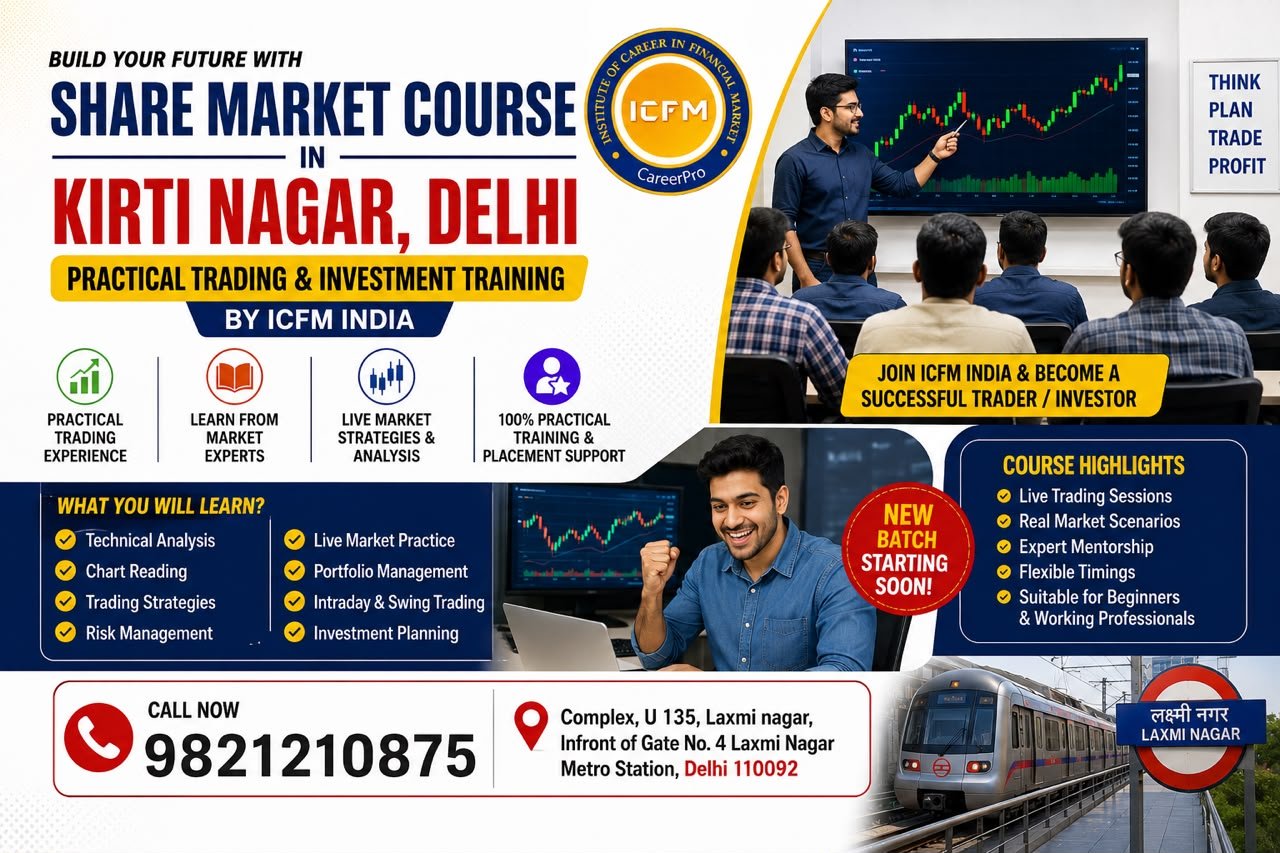
Learn trading, investment, technical analysis, fundamental analysis and risk management with ICFM's Share Market Course in Kirti Nagar. Build practical financial-market skills.
The stock market has become an important part of India’s growing financial ecosystem. From students and working professionals to entrepreneurs and aspiring finance professionals, more people are looking for structured ways to understand equity markets, trading strategies, investment research and risk management.
However, learning the share market is not simply about understanding when to buy or sell a stock. Successful market participation requires knowledge of financial instruments, technical analysis, fundamental research, trading psychology, money management and disciplined decision-making.
If you are searching for a Share Market Course in Kirti Nagar, ICFM – Institute of Career in Financial Market provides structured financial-market education designed to help learners develop practical knowledge and professional skills.
The objective is simple: help students understand how financial markets work and build the knowledge required to approach trading and investment with greater confidence and discipline.
Why Learn the Share Market Through a Structured Course?
The internet contains thousands of videos, articles, tips and trading opinions. While these resources can be useful, learning from scattered information can make it difficult to understand how different concepts connect.
A structured share market course can provide a logical learning path.
Instead of studying technical indicators one day and investment concepts the next, students can progress through a planned curriculum covering:
- Financial market fundamentals
- Equity and market instruments
- Technical analysis
- Fundamental analysis
- Chart reading
- Trading strategies
- Investment planning
- Risk management
- Trading psychology
- Practical market applications
- Professional career preparation
This approach helps learners develop a broader understanding of the market rather than depending on isolated trading tips.
Share Market Course in Kirti Nagar for Beginners and Aspiring Professionals
You do not need to be an experienced trader to start learning about the stock market.
A properly designed course can begin with fundamental concepts and gradually introduce more advanced subjects. This makes the learning process suitable for beginners as well as learners who already have some exposure to financial markets.
Beginners can learn:
- How the Indian stock market works
- What stocks and exchanges are
- How trading accounts operate
- Different types of market orders
- Basic chart interpretation
- Introduction to technical indicators
- Fundamental investment concepts
- Basic risk management
Intermediate learners can explore:
- Price action
- Advanced chart patterns
- Trend identification
- Support and resistance
- Volume analysis
- Trading setups
- Financial statement analysis
- Stock valuation concepts
- Portfolio construction
The goal is to create a progressive learning experience where every concept builds upon the previous one.
What Makes ICFM's Share Market Training Different?
At ICFM, the focus is on combining financial-market knowledge with practical learning.
A strong training program should not only explain definitions. Students should also understand how those concepts are applied when analyzing actual market situations.
1. Practical Market Understanding
Students learn how traders and investors approach market information, analyze price movements and evaluate potential opportunities.
The focus is on understanding the process behind a market decision rather than blindly following calls or tips.
2. Technical Analysis
Technical analysis forms an important part of modern trading education.
The curriculum can cover areas such as:
- Candlestick analysis
- Price action
- Trends and market structure
- Support and resistance
- Chart patterns
- Moving averages
- Momentum indicators
- Volume analysis
- Breakouts and breakdowns
- Intraday trading concepts
- Swing trading approaches
Students learn how different tools can be combined to create a structured analytical framework.
3. Fundamental Analysis
Trading is only one side of the financial market.
For investors, understanding a company's business and financial position is equally important.
Students can learn about:
- Balance sheets
- Profit and loss statements
- Cash-flow statements
- Financial ratios
- Business performance
- Sector analysis
- Industry trends
- Valuation concepts
- Economic factors
- Long-term investment considerations
This provides a broader foundation for evaluating companies rather than relying solely on market price movements.
Learn Risk Management Before Chasing Returns
One of the most important lessons in market education is that trading and investing involve risk.
A professional approach therefore requires risk management to be treated as a core subject, not an optional topic.
ICFM's training approach emphasizes concepts such as:
Position Sizing
Understanding how much capital should be exposed to an individual market position.
Stop-Loss Planning
Learning how predefined exit levels can be incorporated into a trading plan.
Capital Management
Understanding how available capital should be managed across different opportunities.
Diversification
Learning why concentrating capital in a limited number of investments can increase portfolio risk.
Trading Psychology
Understanding how emotions such as fear, greed, impatience and overconfidence can influence decisions.
The purpose of this training is not to promise profits. It is to help learners understand the importance of discipline, planning and risk awareness.
From Charts to Decisions: Developing a Complete Market Approach
Knowing individual indicators is not enough.
For example, seeing a moving-average crossover does not automatically mean that a trade is suitable. Market participants also need to consider trend direction, volatility, support and resistance, volume, risk-to-reward considerations and broader market conditions.
A quality share market course should therefore encourage learners to think in terms of a complete decision-making process.
A practical framework can include:
Market Observation → Analysis → Setup Identification → Risk Assessment → Trade/Investment Decision → Execution → Review
This process helps students understand that successful market participation involves preparation and evaluation rather than impulsive decisions.
Trading Platforms and Market Tools
Modern traders and investors rely on technology to analyze markets and execute transactions.
As part of practical market education, students can become familiar with tools and concepts related to:
- Trading charts
- Market screeners
- Exchange information
- Order types
- Price and volume data
- Technical indicators
- Watchlists
- Research resources
- Portfolio tracking
Learning these tools can make it easier for students to transition from classroom concepts to independent market analysis.
Career-Oriented Share Market Education
A share market course can also be useful for learners who want to explore professional opportunities within the financial-services industry.
The financial sector includes several areas where market knowledge can be valuable.
Depending on qualifications, experience and applicable regulatory requirements, learners may explore career paths such as:
Equity Dealer
Supporting trading activities and monitoring market movements.
Research Support
Assisting with market research, company analysis and financial information.
Investment Operations
Working with processes related to investment and market transactions.
Relationship Management
Supporting clients and communicating financial-market information within the scope of the role.
Trading Desk Support
Assisting market professionals with monitoring and analytical activities.
Financial Market Education
Developing expertise that can support future opportunities in financial training and education.
A course should be viewed as a foundation for developing skills—not as a guarantee of employment or investment returns.
Who Can Join a Share Market Course in Kirti Nagar?
The program can be relevant to a wide range of learners.
College Students
Students interested in finance can begin developing practical market knowledge alongside their academic education.
Fresh Graduates
Graduates can use financial-market training to strengthen their understanding of the industry and explore relevant career paths.
Working Professionals
Professionals looking to develop financial-market knowledge can learn outside their existing area of specialization.
Aspiring Traders
Individuals interested in trading can build a structured foundation instead of relying exclusively on social-media tips.
Investors
Existing investors can strengthen their understanding of company analysis, valuation and portfolio concepts.
Career Switchers
Professionals considering a move toward finance can use structured training as an initial step toward understanding the industry.
Prior stock market experience is not essential for beginning with the fundamentals.
Why Kirti Nagar Learners Can Benefit from Financial-Market Training
Kirti Nagar is one of West Delhi's established commercial and business areas, with strong connectivity to surrounding residential and professional districts.
For learners in and around Kirti Nagar, access to structured financial education can make it easier to develop specialized skills without treating stock-market learning as a random collection of online tutorials.
The advantage of learning through an established institute is the opportunity to follow a curriculum, interact with trainers, ask questions and gradually develop an analytical mindset.
For students and working professionals, flexible learning options can also make it easier to balance education with existing commitments.
What You Should Look for Before Choosing a Share Market Course
Choosing a financial-market course should involve more than comparing course fees.
Before enrolling, learners should evaluate:
Curriculum Quality
Does the syllabus cover both trading and investment concepts?
Practical Learning
Does the training explain how concepts are applied to real market situations?
Trainer Expertise
Do instructors have relevant market and teaching experience?
Risk Education
Does the program teach risk management and trading psychology?
Career Relevance
Does the curriculum help learners understand professional roles within financial markets?
Learning Support
Can students ask questions and receive guidance during and after training?
Transparency
Are the course structure, fees, duration and learning outcomes clearly communicated?
These factors can help students make a more informed decision.
A Structured Learning Path for Your Market Journey
A well-organized share market learning journey can progress through several stages:
Stage 1 – Understand
Learn the fundamentals of markets, stocks, exchanges and financial instruments.
Stage 2 – Analyze
Develop technical and fundamental analysis skills.
Stage 3 – Practice
Apply concepts to market charts, financial information and practical examples.
Stage 4 – Manage Risk
Understand position sizing, stop-loss planning and capital management.
Stage 5 – Build Discipline
Develop a consistent process for evaluating market decisions.
Stage 6 – Develop Professionally
Explore financial-market career opportunities and continue building relevant skills.
This progression is more valuable than trying to master advanced strategies without first understanding the fundamentals.
Why ICFM Focuses on Skill Development
ICFM – Institute of Career in Financial Market focuses on financial-market education with an emphasis on structured learning and practical understanding.
The objective is to help students move beyond basic terminology and develop the ability to:
- Read and interpret market charts
- Understand company financial information
- Evaluate market trends
- Develop analytical thinking
- Understand trading and investment strategies
- Apply risk-management principles
- Use market-analysis tools
- Approach financial decisions more systematically
The emphasis is on education, practice and disciplined analysis, rather than unrealistic promises about market returns.
Build Knowledge Before Taking Market Decisions
The stock market can create opportunities, but it also involves substantial financial risk.
No course, strategy or indicator can guarantee profits. Market conditions change, and past performance does not ensure future results.
That is why quality financial education should focus on knowledge, risk awareness, analytical skills and disciplined decision-making.
If you are searching for a Share Market Course in Kirti Nagar, choosing a structured learning program can be an important first step toward understanding the financial markets more professionally.
Start Your Share Market Learning Journey with ICFM
Whether your objective is to understand investing, learn technical analysis, explore trading or develop skills for a future finance career, the right education can provide a stronger foundation.
ICFM aims to help learners develop practical financial-market knowledge through structured training covering trading, investment, technical analysis, fundamental analysis, risk management and career-oriented skills.
Share Market Course in Kirti Nagar – Learn. Practice. Analyze. Grow.
ICFM – Institute of Career in Financial Market
Address: Complex, U 135, Laxmi Nagar, In front of Gate No. 4, Laxmi Nagar Metro Station, Delhi – 110092
Phone: +91 9821210875
Email: info@icfmindia.in
Website: www.icfmindia.in
For course details, eligibility, batch schedules and admissions, contact ICFM directly.

ICFM Admin
Senior Trading Analyst at ICFM India
Rahul Rai is a certified market professional with over 12 years of experience in equity and derivatives trading. He specializes in technical analysis and margin trading strategies, and has trained over 5,000 students through ICFM India's certification programs.