
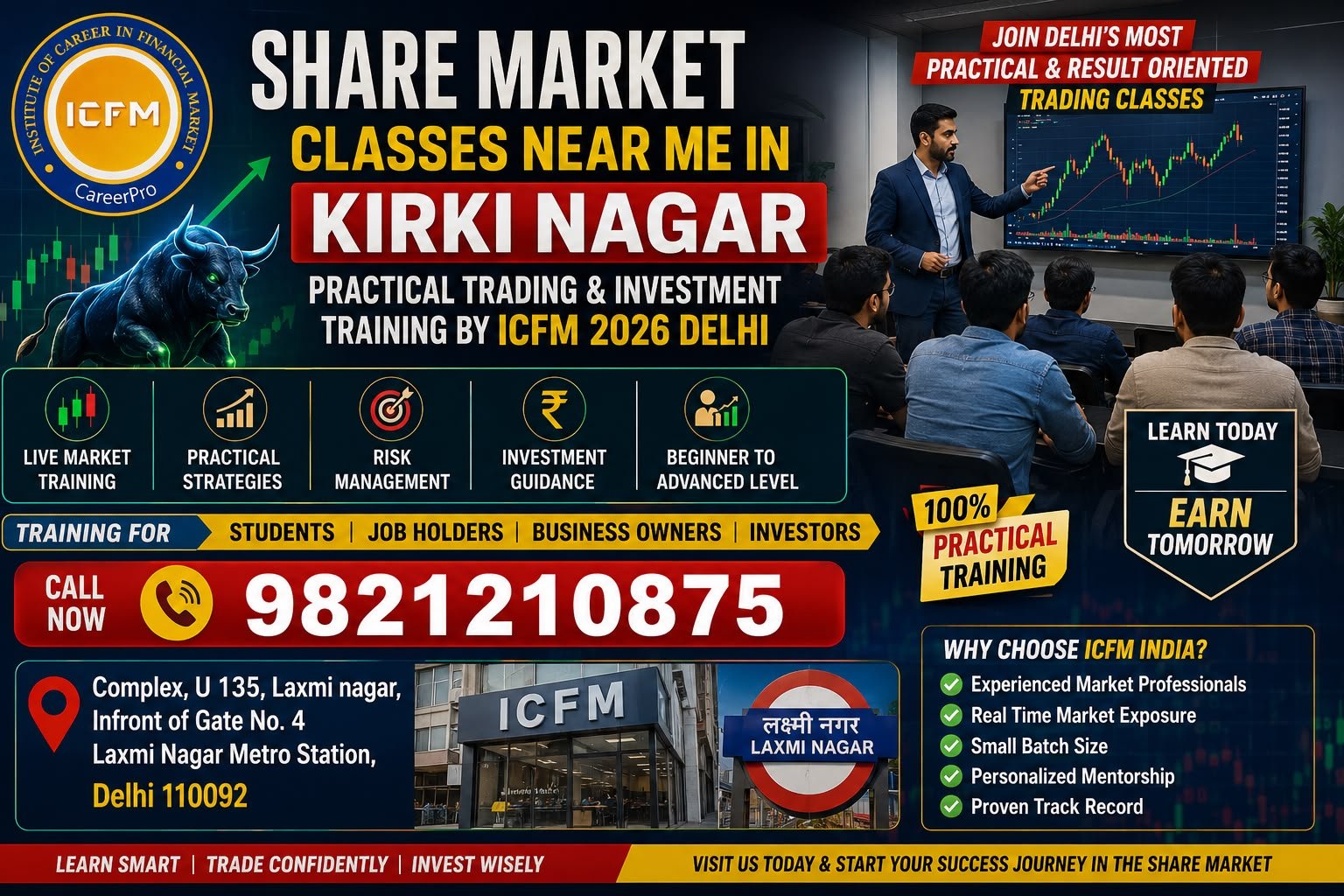
Learn practical share market classes near me in Kirti Nagar with ICFM. Build knowledge of technical analysis, fundamental analysis, trading strategies, investment concepts, risk management, and market tools through structured financial-market training.
If you have searched for “share market classes near me in Kirti Nagar”, you are probably looking for more than a basic introduction to the stock market. You may want to understand how stocks work, how to read charts, how investors evaluate companies, how trades are executed, and most importantly, how to manage risk before entering the market.
That is where structured financial-market education can make a difference.
ICFM – Institute of Career in Financial Market offers practical stock market education designed to help students, beginners, investors, and aspiring finance professionals develop a stronger understanding of trading and investment.
Instead of treating the stock market as a shortcut to quick profits, the right learning approach focuses on knowledge, analysis, discipline, risk management, and practical decision-making.
Why People in Kirti Nagar Are Looking for Stock Market Education
Kirti Nagar is widely known as a commercial and business-oriented part of West Delhi. With students, working professionals, business owners, and young people exploring additional career skills, financial-market education has become an increasingly relevant learning option.
A search for share market classes near me in Kirti Nagar can lead to many different types of training providers. Current online listings show multiple stock-market and technical-analysis training options serving Kirti Nagar and nearby areas.
The challenge is not simply finding a class.
The real question is:
What should you actually learn before calling yourself a trader or investor?
A quality program should answer that question through a structured curriculum.
What Should You Learn in Share Market Classes?
A good share market course should take you beyond terminology such as Sensex, Nifty, shares, and IPOs.
You should gradually learn how different parts of the market connect.
1. Understanding the Financial Market
Beginners first need a clear foundation.
You can learn about:
- Stock exchanges
- Equity markets
- Nifty and Sensex
- Market participants
- Brokers and trading accounts
- Demat accounts
- Order types
- Market timings
- Corporate actions
- Primary and secondary markets
This foundation helps you understand what is happening before you start analysing individual stocks.
2. Technical Analysis
Technical analysis is an important part of trading education because it teaches you how to study price and volume behaviour.
The training can cover:
- Candlestick charts
- Trend identification
- Support and resistance
- Chart patterns
- Price action
- Moving averages
- Momentum indicators
- Volume analysis
- Breakouts and breakdowns
- Multiple-timeframe analysis
- Intraday trading concepts
- Swing trading concepts
The objective should not be to memorize dozens of indicators.
It should be to understand why a particular market setup matters and what risks are involved.
3. Fundamental Analysis for Investors
Trading and investing are not the same activity.
While traders may focus heavily on price behaviour and market momentum, investors often need to understand the underlying business.
A practical investment module can introduce:
- Balance sheets
- Profit and loss statements
- Cash-flow statements
- Revenue and earnings
- Financial ratios
- Company valuation
- Sector analysis
- Industry trends
- Economic factors
- Business quality
- Long-term investment principles
This gives learners a broader perspective when evaluating companies.
4. Risk Management – The Skill Beginners Often Ignore
Learning how to enter a trade is only one part of market education.
Knowing how much you can afford to risk is equally important.
A professional-oriented course should introduce concepts such as:
- Position sizing
- Stop-loss planning
- Risk-to-reward ratio
- Capital allocation
- Portfolio diversification
- Drawdown management
- Trading discipline
- Emotional decision-making
There is no guaranteed strategy that removes market risk.
Good education should therefore teach you how to recognize, measure, and manage risk rather than promise guaranteed returns.
5. Learn How Trading Platforms Work
Knowing market theory is not enough if you cannot operate the tools used to analyse and execute trades.
Practical training can include exposure to:
- TradingView
- NSE market information
- Charting platforms
- Stock screeners
- Market scanners
- Order placement
- Limit orders
- Market orders
- Stop-loss orders
- Position monitoring
Learning the workflow helps beginners become more comfortable with the actual market environment.
Share Market Classes Near Me in Kirti Nagar: What Makes a Course Worth Choosing?
When comparing institutes, do not choose only on the basis of advertisements or course fees.
Instead, evaluate the learning experience.
Look for these important factors:
Practical Training
Does the course include market-based examples and practical exercises?
Complete Curriculum
Does it cover both technical and fundamental analysis?
Risk Management
Is risk management taught as seriously as entry and exit strategies?
Experienced Faculty
Can instructors explain market concepts clearly instead of simply giving signals?
Tools & Platforms
Will you learn how to use professional market-analysis tools?
Career Guidance
If your goal is employment, does the institute provide interview and career preparation?
Post-Course Support
Can you continue asking questions after completing the program?
These questions can help you distinguish structured education from courses that focus mainly on promotional claims.
Why Choose ICFM for Share Market Learning?
ICFM – Institute of Career in Financial Market focuses on practical financial-market education covering trading, investment, technical analysis, fundamental analysis, risk management, and related market skills.
ICFM's current website also features a Share Market Course in Kirti Nagar, Delhi, positioned around practical trading and investment training.
The learning approach is designed around a progression:
Foundation → Analysis → Strategy → Practical Application → Risk Management → Career Preparation
This structure helps beginners build their knowledge step by step rather than attempting advanced strategies without understanding the basics.
What Can You Learn at ICFM?
Beginner-Level Learning
If you are completely new to the market, you can start with:
- Stock market basics
- Equity concepts
- Demat and trading account understanding
- Market terminology
- Charts and candles
- Basic investment concepts
Intermediate Learning
Once the foundation is clear, learners can move toward:
- Technical analysis
- Fundamental analysis
- Trading strategies
- Chart patterns
- Market screening
- Risk management
- Trading psychology
Advanced Market Skills
Depending on the program, learners can explore more advanced concepts such as:
- Advanced technical analysis
- Strategy development
- Advanced chart interpretation
- Derivatives concepts
- Portfolio approaches
- Professional market workflows
Share Market Classes for Beginners in Kirti Nagar
You do not necessarily need previous stock market experience to begin learning.
A beginner-friendly program should explain concepts in a logical order rather than assuming that every learner already understands financial terminology.
For a new learner, the ideal progression is:
Step 1: Understand the market
Step 2: Learn how stocks are analysed
Step 3: Understand technical charts
Step 4: Learn fundamental analysis
Step 5: Study risk management
Step 6: Practice analysis
Step 7: Develop a disciplined process
This approach can be more valuable than simply learning a list of trading tips.
Share Market Classes Near Kirti Nagar for Students and Working Professionals
Financial-market education is not limited to one age group.
A structured course can be useful for:
College Students
Students interested in finance, economics, business, or investment can build practical market knowledge alongside their academic education.
Working Professionals
Professionals can use market education to develop an additional financial skill or explore career opportunities in the financial-services industry.
Career Switchers
People moving toward finance-related roles can use structured training to strengthen their practical understanding of markets.
New Investors
Beginners who want to understand investing before committing significant capital can learn the fundamentals first.
Aspiring Traders
Individuals interested in trading can study technical analysis, risk management, psychology, and strategy development in a structured environment.
Trading Is Not the Same as Investing
One of the most important lessons for a beginner is understanding the difference.
Trading generally focuses on shorter-term market opportunities and price movements.
Investing generally focuses on ownership of businesses and longer-term wealth-building objectives.
Both require different approaches.
A comprehensive share market education program should therefore explain:
| Trading | Investing |
|---|---|
| Price movement | Business performance |
| Technical analysis | Fundamental analysis |
| Shorter time horizons | Longer time horizons |
| Entry and exit planning | Valuation and business quality |
| Position sizing | Portfolio allocation |
| Stop-loss management | Diversification |
Understanding this difference can prevent beginners from approaching every stock with the same strategy.
Career Opportunities After Learning the Stock Market
If your objective is professional development rather than personal investing alone, financial-market education can help you understand different career paths.
Depending on your qualifications, experience, and additional certifications, possible roles across the financial-services industry may include:
- Equity Dealer
- Research Support Executive
- Financial Market Executive
- Trading Desk Assistant
- Investment Operations Executive
- Client Relationship Executive
- Market Research Associate
- Portfolio Support Executive
- Business Development Executive in Financial Services
A course does not automatically guarantee employment. Career outcomes depend on your skills, qualifications, performance, and the requirements of individual employers.
Practical Learning vs. Theory-Only Classes
Imagine learning to drive only by reading a manual.
You might understand the terminology, but you would still need practical experience before becoming comfortable behind the wheel.
Market education works in a similar way.
Reading about candlestick patterns is different from analysing an actual chart.
Reading about stop-losses is different from understanding how risk changes with position size.
Memorizing financial ratios is different from comparing two companies.
That is why practical exercises, chart analysis, market examples, assignments, and guided learning can make a significant difference.
How ICFM Can Help Build a Stronger Market Learning Foundation
The goal should not be to make a beginner dependent on someone else's buy or sell calls.
The stronger objective is to develop independent analytical thinking.
ICFM's approach focuses on helping learners understand:
What is happening?
Understand the market environment.
Why is it happening?
Analyse price, volume, fundamentals, and broader factors.
What could happen next?
Build possible scenarios rather than assuming certainty.
What is the risk?
Determine whether the potential opportunity justifies the risk.
How should capital be managed?
Use appropriate position sizing and risk controls.
This way of thinking is more useful than simply following market tips.
Frequently Asked Questions
Are share market classes near me in Kirti Nagar suitable for beginners?
Yes. Beginners can start with foundational concepts and gradually move toward technical analysis, fundamental analysis, trading strategies, and risk management.
Do I need a finance degree to learn the stock market?
No. Basic financial literacy and willingness to learn are useful starting points. Advanced professional roles may have their own educational and regulatory requirements.
Can I learn both trading and investing?
Yes. A comprehensive curriculum can introduce both technical approaches used in trading and fundamental approaches used in investing.
Is stock market training a guarantee of profit?
No. No genuine educational institute can guarantee stock market profits. Market prices involve risk, and actual results vary from person to person.
Should I learn technical analysis or fundamental analysis first?
Beginners should understand market fundamentals first and then progressively learn both technical and fundamental analysis. The right emphasis depends on whether your objective is trading, investing, or a combination of both.
Are online classes available?
ICFM provides financial-market learning options, and its website currently promotes practical stock market courses for learners in Delhi locations including Kirti Nagar.
Start Learning the Stock Market with a Structured Approach
Searching for “share market classes near me in Kirti Nagar” should be the beginning of your research, not the end.
Before joining any institute, compare the curriculum, practical exposure, faculty experience, learning support, tools covered, and career guidance.
The stock market rewards preparation, discipline, patience, and continuous learning. There are no shortcuts that eliminate risk.
If you want to build your understanding systematically, ICFM can provide a structured environment for learning stock market trading, investment, technical analysis, fundamental analysis, and risk management.
Enquire About ICFM's Share Market Training
ICFM – Institute of Career in Financial Market
Address: Complex, U 135, Laxmi Nagar, In Front of Gate No. 4, Laxmi Nagar Metro Station, Delhi – 110092
Phone: +91 9821210875
Email: info@icfmindia.in
Website: www.icfmindia.in
Build knowledge before taking market decisions.
Learn the market. Understand the risk. Develop your own analytical process.

ICFM Admin
Senior Trading Analyst at ICFM India
Rahul Rai is a certified market professional with over 12 years of experience in equity and derivatives trading. He specializes in technical analysis and margin trading strategies, and has trained over 5,000 students through ICFM India's certification programs.