
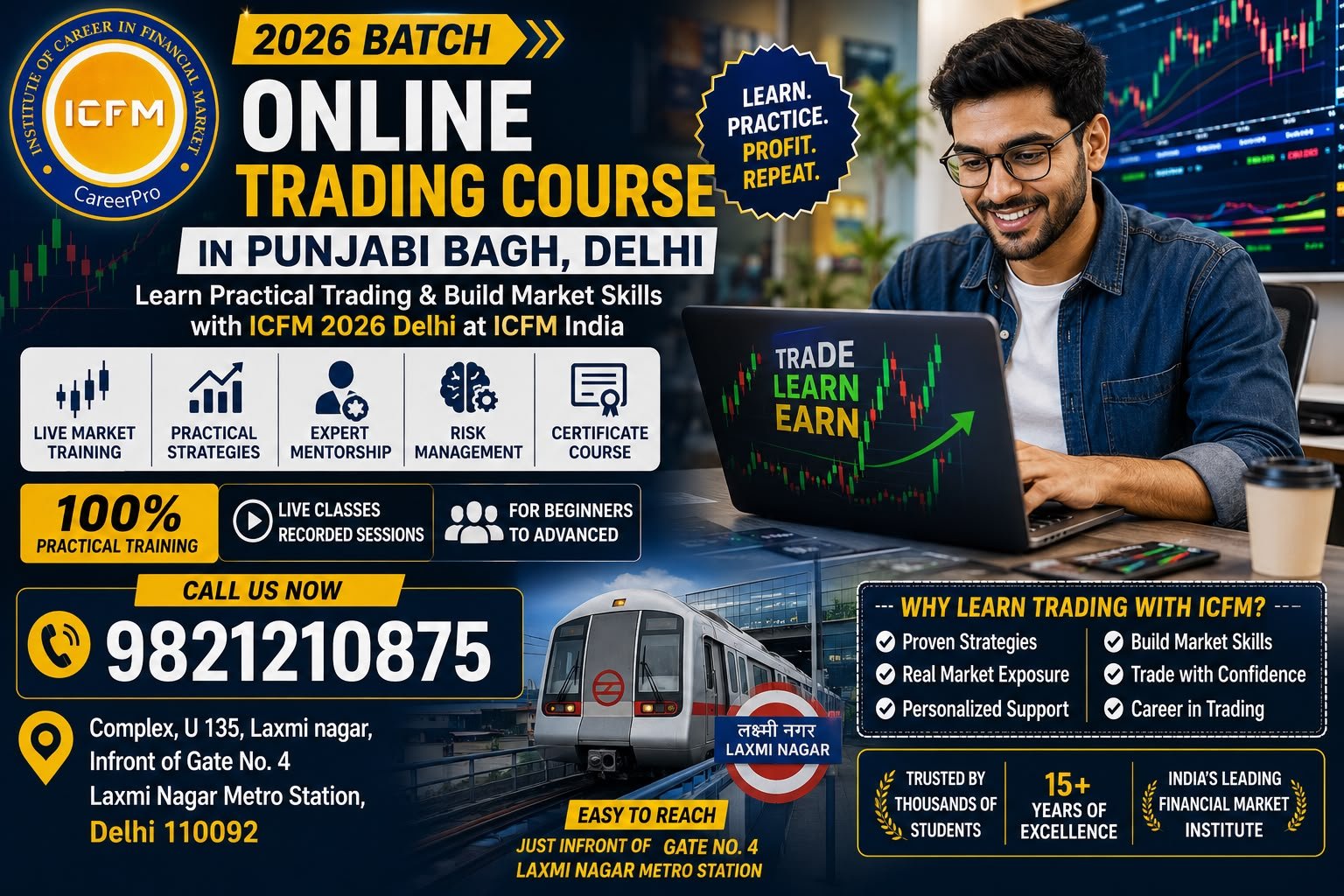
Learn practical trading skills with ICFM’s Online Trading Course in Punjabi Bagh. Understand technical analysis, fundamental analysis, risk management, trading psychology, market tools, and practical trading concepts through structured online training. Suitable for beginners, students, working professionals, traders, and investors. Enquire with ICFM today.
The financial markets are becoming an increasingly important part of the modern economy, creating opportunities for people who want to understand trading, investing, technical analysis, and market research. However, successful participation in the market requires more than simply opening a trading account or following market tips.
If you are searching for an Online Trading Course in Punjabi Bagh, ICFM – Institute of Career in Financial Market offers a structured learning program designed to help students, working professionals, beginners, and aspiring market participants develop practical knowledge of the stock market.
The objective is simple: help learners understand how financial markets work, how trading decisions are planned, how risk is managed, and how professional market analysis is performed.
Rather than relying only on theoretical concepts, the course focuses on practical understanding, market-oriented education, chart analysis, trading tools, risk management, and disciplined decision-making.
Why Learn Trading Through an Online Course?
Online financial education has changed the way people acquire professional skills. Learners no longer need to travel every day to attend a classroom. With a structured online trading course, students can learn from home, from the workplace, or from anywhere with a reliable internet connection.
For learners in Punjabi Bagh, online training can be particularly useful because it provides flexibility without compromising access to professional financial-market education.
An effective online trading program can help you:
- Understand stock market fundamentals
- Learn technical analysis systematically
- Study price movements and market trends
- Understand different trading styles
- Practice chart-based analysis
- Learn risk management principles
- Understand trading platforms and market tools
- Develop a disciplined approach to decision-making
- Build knowledge useful for finance-related career opportunities
The goal should not be to chase quick profits. The goal should be to develop knowledge, process, discipline, and risk awareness.
Online Trading Course in Punjabi Bagh – What Makes ICFM Different?
Choosing a trading course is an important decision because the quality of education can significantly influence how well a learner understands the market.
ICFM focuses on structured financial-market education that combines fundamental concepts with practical learning.
1. Practical Market-Oriented Learning
Trading cannot be understood completely by reading definitions. Learners need to understand how concepts are applied to actual market situations.
The course introduces learners to chart interpretation, market movements, trading setups, order execution, and risk-management principles.
2. Beginner-Friendly Learning Structure
You do not need to be an experienced trader to begin learning.
The curriculum starts with basic financial-market concepts and gradually progresses toward technical analysis, trading strategies, risk management, and advanced market concepts.
3. Technical Analysis
Technical analysis is an important part of modern trading education.
Learners can develop an understanding of:
- Candlestick structures
- Support and resistance
- Trend identification
- Chart patterns
- Volume analysis
- Moving averages
- Momentum indicators
- Breakouts and breakdowns
- Price action
- Intraday analysis
- Swing-trading concepts
The emphasis is on understanding why a particular setup may matter, rather than blindly following signals.
4. Risk Management
One of the biggest differences between casual market participation and disciplined trading is risk management.
Learners are introduced to concepts such as:
- Position sizing
- Stop-loss planning
- Capital allocation
- Risk-to-reward concepts
- Portfolio diversification
- Trading discipline
- Drawdown awareness
- Emotional decision-making
Understanding risk is essential because financial markets involve uncertainty and no strategy can guarantee profits.
What Will You Learn in the Online Trading Course?
ICFM's online trading education can be approached as a complete learning journey rather than a collection of disconnected topics.
Module 1: Understanding the Financial Market
The first stage establishes a strong foundation.
Topics include:
- Introduction to financial markets
- Equity markets
- Stock exchanges
- NSE and BSE concepts
- Market participants
- Demat and trading accounts
- Primary and secondary markets
- Market orders and limit orders
- Trading terminology
A strong foundation makes advanced concepts easier to understand.
Module 2: Technical Analysis
Technical analysis helps traders study historical price and volume information to identify potential market patterns.
Learners can explore:
- Candlestick analysis
- Trendlines
- Support and resistance
- Chart patterns
- Volume
- Moving averages
- RSI and other indicators
- Momentum analysis
- Breakout concepts
- Price-action techniques
The objective is to teach learners how to build a logical analytical process.
Module 3: Intraday Trading Concepts
Intraday trading requires planning, discipline, and risk control.
The course introduces concepts related to:
- Intraday market structure
- Time-frame selection
- Entry and exit planning
- Stop-loss placement
- Trade management
- Position sizing
- Market volatility
- Trading psychology
Students learn why every trade should have a defined plan rather than being based on emotion or speculation.
Module 4: Swing Trading
Not every learner wants to trade within a single day.
Swing trading concepts help learners understand how traders may analyze market movements over a longer period.
Topics include:
- Trend identification
- Breakout setups
- Pullback concepts
- Entry planning
- Exit strategies
- Risk-reward planning
- Position management
This provides learners with an understanding of different approaches to market participation.
Module 5: Fundamental Analysis
Trading education becomes more valuable when learners understand the difference between technical and fundamental perspectives.
Fundamental analysis may include:
- Company financial statements
- Balance sheets
- Profit and loss statements
- Cash-flow analysis
- Business fundamentals
- Sector analysis
- Economic indicators
- Valuation concepts
This knowledge is particularly useful for people interested in investment research and long-term decision-making.
Learn Professional Trading Tools
Modern traders rely on technology for market analysis and execution.
As part of practical market education, learners can become familiar with tools and platforms used for:
- Chart analysis
- Market screening
- Price tracking
- Technical indicators
- Trading analysis
- Market research
- Order placement concepts
Understanding technology can help learners move from theoretical knowledge toward a more practical market workflow.
Trading Psychology: The Skill Many Beginners Ignore
Knowledge alone does not guarantee disciplined decision-making.
Fear, greed, overconfidence, impatience, and revenge trading can influence market participants.
A quality trading education should therefore address trading psychology.
Learners can develop awareness of:
- Emotional decision-making
- Overtrading
- FOMO
- Loss acceptance
- Trading discipline
- Following a predefined plan
- Maintaining realistic expectations
The objective is to build a mindset where decisions are based on analysis and predefined risk parameters, rather than emotions.
Who Should Join an Online Trading Course in Punjabi Bagh?
The program can be useful for a wide range of learners.
College Students
Students interested in finance can develop practical knowledge alongside their academic education.
Beginners
Those who have never traded before can start with the fundamentals and gradually progress.
Working Professionals
Professionals can use online learning to build financial-market skills without changing their existing schedules.
Career Switchers
People considering a transition into finance, broking, research, or related fields can develop relevant market knowledge.
Existing Traders
Traders who have learned through social media, informal sources, or trial and error can benefit from structured education.
Investors
Long-term investors can improve their understanding of financial markets, company analysis, and market behaviour.
Career Opportunities After Learning Trading
Trading education can provide knowledge relevant to several areas of the financial-services industry.
Depending on qualifications, skills, experience, and regulatory requirements, learners may explore roles such as:
- Equity Dealer
- Trading Desk Executive
- Research Executive
- Market Research Associate
- Investment Operations Executive
- Client Relationship Executive
- Financial Market Trainer
- Portfolio Support Executive
- Broking Operations Executive
- Independent Trader or Investor
A course should be viewed as a skill-building foundation, not as a guarantee of employment or trading income.
Why Choose ICFM for Online Financial Market Education?
ICFM – Institute of Career in Financial Market has focused on financial-market education with an emphasis on practical knowledge and professional development.
The learning approach is designed around several important principles:
Structured Curriculum
Topics are arranged progressively, helping learners move from basic concepts toward advanced market analysis.
Practical Orientation
The emphasis is on understanding how concepts work in real market situations.
Experienced Guidance
Learners receive guidance designed to make complex financial concepts easier to understand.
Career Perspective
The curriculum can help learners understand the skills relevant to different areas of the financial-services industry.
Flexible Learning
Online education provides learners with greater flexibility in accessing training.
Online Trading Course vs Learning Through Random Online Videos
The internet contains thousands of trading videos, tutorials, tips, and opinions. While these resources can be useful for exploration, beginners often face one major problem: lack of structure.
Random content can create confusion because one video may discuss intraday trading, another may promote indicators, and another may focus on long-term investing.
A structured course provides a learning sequence:
Basics → Technical Analysis → Fundamental Analysis → Trading Concepts → Risk Management → Psychology → Practical Application
This structured progression can make learning more efficient and easier to follow.
What Makes a Good Trading Course?
Before selecting any trading program, learners should evaluate the quality of the curriculum rather than choosing a course only because of promotional claims.
Look for:
- Clearly defined syllabus
- Experienced instructors
- Practical market education
- Risk-management training
- Technical and fundamental analysis
- Trading-platform education
- Doubt-solving support
- Career guidance where applicable
- Transparent course information
- Realistic expectations
Most importantly, avoid any course that presents the stock market as a guaranteed source of quick income.
Build Skills Before Taking Market Risk
One of the most important principles for new traders is to understand the difference between education and speculation.
Financial markets carry risk. Even experienced professionals cannot predict every market movement.
Education can help you understand:
- How markets operate
- How to analyze information
- How to create a trading plan
- How to manage risk
- How to evaluate potential opportunities
- How to control emotional decisions
However, learning does not eliminate market risk, and no educational institute can legitimately guarantee trading profits.
The objective of professional education is to help learners make better-informed and more disciplined decisions.
Why Punjabi Bagh Learners Can Benefit from Online Training
Punjabi Bagh is a well-connected part of West Delhi with a large student, professional, business, and residential community.
For learners who want to study financial markets without spending additional time commuting to every class, an online format can offer an efficient alternative.
You can learn from your preferred location while following a structured curriculum designed around financial-market skills.
Whether your objective is to understand trading, improve your existing market knowledge, or explore a career in financial services, structured online education can provide a strong starting point.
Start Your Financial Market Learning Journey with ICFM
Learning the stock market is a process. It requires patience, continuous practice, analytical thinking, and disciplined risk management.
If you are searching for an Online Trading Course in Punjabi Bagh, ICFM provides a structured learning environment designed to help learners understand the market from fundamentals to practical applications.
Instead of searching for shortcuts, focus on developing the skills that remain valuable across changing market conditions.
Learn the market. Understand the risk. Build the skill. Develop the discipline.
Admissions & Course Information
ICFM – Institute of Career in Financial Market
Address: Complex, U 135, Laxmi Nagar, In front of Gate No. 4, Laxmi Nagar Metro Station, Delhi – 110092
Phone: +91 9821210875
Email: info@icfmindia.in
Website: www.icfmindia.in
Online Trading Course in Punjabi Bagh – Enquire Today
Take the first step toward understanding financial markets through structured and practical education with ICFM.
Important: Trading and investing involve market risk. This course is intended for educational and skill-development purposes and does not guarantee profits, returns, or employment.

ICFM Admin
Senior Trading Analyst at ICFM India
Rahul Rai is a certified market professional with over 12 years of experience in equity and derivatives trading. He specializes in technical analysis and margin trading strategies, and has trained over 5,000 students through ICFM India's certification programs.