
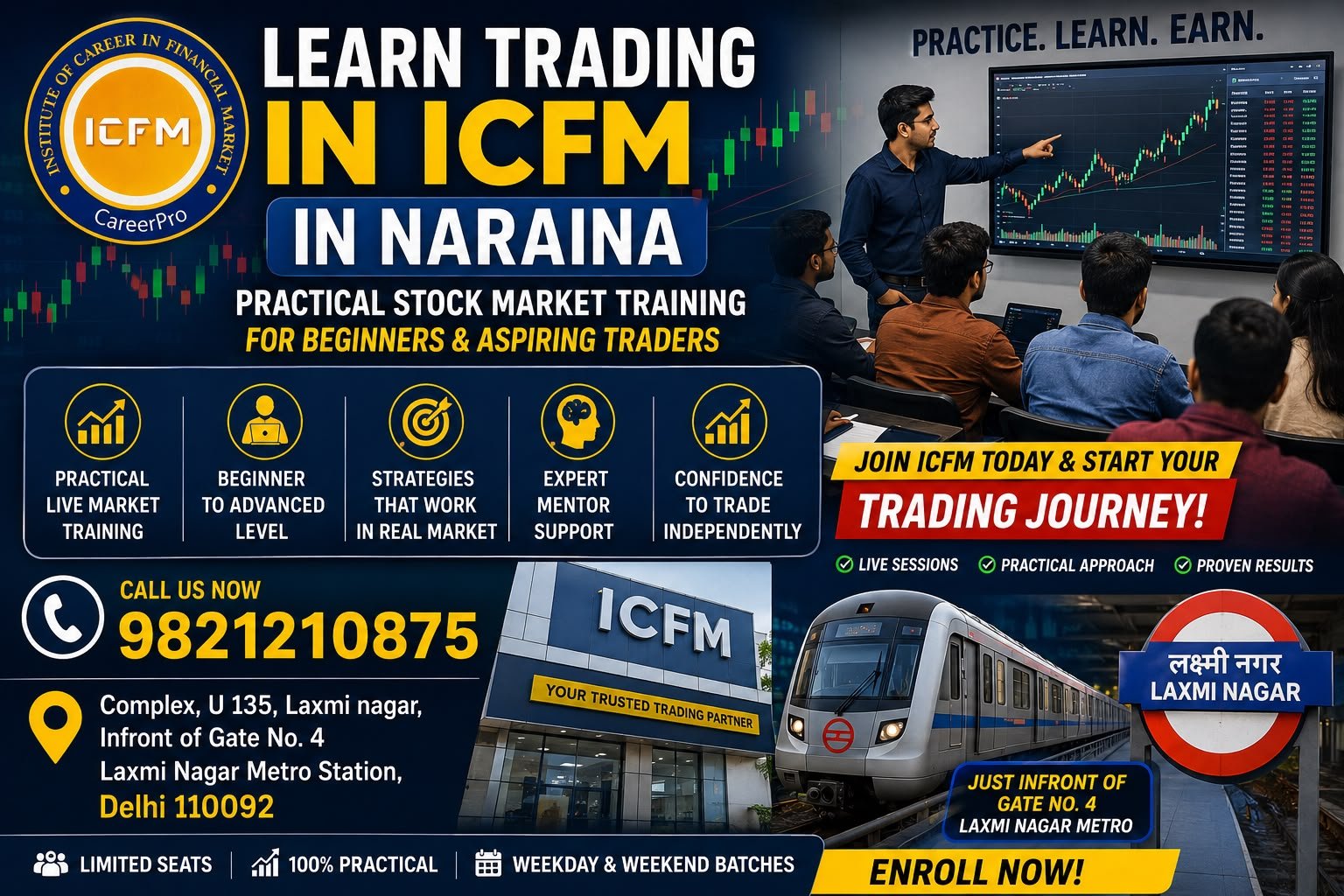
Learn trading in ICFM in Naraina with practical stock market training covering technical analysis, trading strategies, risk management, trading psychology and market tools.
Learning trading is not simply about finding a stock and placing an order. Successful market participation requires an understanding of price behaviour, technical analysis, risk management, trading psychology, market structure, and disciplined decision-making.
For students, professionals, beginners, and aspiring finance-sector candidates looking to learn trading in ICFM in Naraina, ICFM provides a structured learning environment focused on developing practical stock market skills.
The objective is simple: help learners understand how financial markets work, how trading decisions are planned, how risk is controlled, and how market information can be analysed before taking a position.
Instead of depending entirely on tips or random strategies, students are introduced to a systematic approach to trading and investment.
Why Learning Trading Requires More Than Watching Market Videos
The internet has made stock market information easily accessible. Thousands of videos, social media posts, indicators, and trading opinions are available every day.
However, information alone does not create a skilled trader.
A learner needs to understand:
- Why a market is moving
- How to identify a trend
- How support and resistance work
- How volume can support price analysis
- How to identify potential entry and exit areas
- How stop-loss levels are planned
- How position size affects risk
- How emotions influence trading decisions
- How different market conditions require different approaches
This is where structured education becomes valuable.
At ICFM, trading education is designed to move from fundamentals to practical application, helping learners develop their own analytical framework rather than simply following market calls.
ICFM Naraina: A Structured Approach to Trading Education
ICFM – Institute of Career in Financial Market focuses on financial-market education with an emphasis on practical learning.
The training approach can help learners understand the market in stages:
Learn → Analyse → Practise → Manage Risk → Review → Improve
This process is important because trading is a skill that develops through continuous learning and disciplined practice.
Rather than presenting trading as a shortcut to making money, the focus is on understanding the market and developing responsible decision-making skills.
What Can You Learn at ICFM?
A comprehensive trading program should cover much more than basic buy-and-sell concepts.
At ICFM, learners can explore important areas of the financial markets, including:
1. Stock Market Fundamentals
Beginners first need to understand the foundation of the market.
Topics can include:
- What is the stock market?
- How stock exchanges operate
- NSE and BSE basics
- Market participants
- Equity and other financial instruments
- Trading accounts and demat accounts
- Market orders and limit orders
- Bid and ask prices
- Market timing and settlement concepts
A strong foundation makes advanced trading concepts easier to understand.
Technical Analysis: Understanding Price and Market Behaviour
Technical analysis is an important part of trading education because traders frequently use charts and market data to study price behaviour.
Learners can develop knowledge of:
Candlestick Analysis
Candlesticks provide information about opening, closing, high, and low prices.
Understanding common candlestick structures can help traders interpret market behaviour instead of looking at price charts randomly.
Support and Resistance
Support and resistance are fundamental concepts used to identify areas where price may react.
Students can learn how these levels are identified and how they can be incorporated into a trading plan.
Trend Analysis
Markets can move upward, downward, or sideways.
Learning how to distinguish between different market conditions is important because a strategy that works in a strong trend may not perform similarly in a range-bound market.
Indicators and Oscillators
Trading education can also introduce learners to commonly used technical tools such as:
- Moving averages
- RSI
- MACD
- Bollinger Bands
- Volume indicators
- Momentum indicators
The important part is not learning dozens of indicators. It is understanding when a tool is useful, what it measures, and what its limitations are.
Learn Intraday Trading with a Disciplined Approach
Intraday trading involves opening and closing positions during the same trading session.
Because intraday markets can move quickly, beginners need to understand:
- Market volatility
- Entry planning
- Exit planning
- Stop-loss placement
- Position sizing
- Risk-reward concepts
- Trading discipline
- Avoiding overtrading
ICFM's practical training approach can help learners understand how an intraday trading plan is constructed and evaluated.
The emphasis should always remain on process and risk management, rather than promises of guaranteed returns.
Understand Swing Trading and Positional Strategies
Not every trader wants to monitor the market throughout the day.
Swing and positional approaches may involve holding a position for a longer period based on a defined strategy.
Learners can study concepts such as:
- Trend identification
- Chart patterns
- Breakouts
- Pullbacks
- Support and resistance
- Entry and exit planning
- Stop-loss management
- Position management
Understanding different trading styles allows learners to identify which approach better fits their objectives, availability, and risk tolerance.
Risk Management: The Skill Every Trader Needs
One of the biggest differences between learning trading professionally and simply following market tips is the importance given to risk management.
A trading strategy is incomplete without a risk-management framework.
Students can learn about:
Position Sizing
The amount invested in a trade should be considered in relation to the overall trading capital and acceptable risk.
Stop Loss
A stop-loss can be used to define the point at which a trader exits a position when the market moves against the planned setup.
Risk-Reward Ratio
Before entering a trade, traders can compare the potential reward with the amount they are willing to risk.
Capital Management
Capital preservation is an important part of long-term market participation.
The objective is not to win every trade. No trading strategy can guarantee that.
The objective is to create a process where losses are controlled and decisions are made systematically.
Trading Psychology: The Human Side of the Market
Charts and indicators are only one part of trading.
The other part is the trader.
Fear, greed, impatience, overconfidence, and revenge trading can influence decision-making.
Professional trading education therefore needs to address behavioural discipline.
Learners can understand:
- Why traders overtrade
- How emotional decisions develop
- Why following a trading plan matters
- How to maintain discipline after a loss
- Why patience is important
- How trading journals can improve decision-making
Developing emotional discipline can be just as important as learning technical indicators.
Learn Fundamental Analysis for Investment Decisions
Trading education can also benefit from an understanding of fundamental analysis.
Fundamental analysis focuses on the underlying business and economic factors that may influence a company's value.
Students can explore:
- Revenue and profit
- Balance sheets
- Cash flow
- Earnings
- Financial ratios
- Business models
- Industry analysis
- Economic factors
- Company performance
This broader knowledge helps learners understand the difference between short-term price movements and long-term investment considerations.
Practical Market Learning at ICFM
One of the key advantages of structured financial-market education is the opportunity to connect concepts with practical market situations.
Instead of learning technical terms in isolation, students can work through examples involving:
Chart → Market Condition → Trading Setup → Entry → Risk → Exit → Review
This approach encourages learners to ask the right questions before taking a trade.
For example:
- What is the current trend?
- Where is the important support?
- Where is resistance?
- What confirms the setup?
- Where would the trade become invalid?
- How much capital should be allocated?
- What is the risk?
- What is the planned exit?
This way of thinking can help transform theoretical knowledge into a repeatable process.
Trading Tools You Can Learn to Use
Modern traders rely on technology to analyse financial markets.
A structured trading course can introduce students to tools and platforms used for:
- Chart analysis
- Market screening
- Price monitoring
- Technical analysis
- Order placement
- Market research
- Portfolio tracking
Learners can become familiar with platforms such as TradingView and relevant exchange-based market resources as part of their practical training.
The goal is not simply to learn software. It is to understand how tools support better analysis and decision-making.
Why Learn Trading in Naraina?
Naraina is an established commercial and industrial area of West Delhi with connectivity to several important parts of the city.
For students and working professionals in and around Naraina, learning financial-market skills locally can make regular classroom participation more convenient.
ICFM's training can be relevant for learners from nearby areas such as:
- Naraina
- Naraina Vihar
- Mayapuri
- Kirti Nagar
- Moti Nagar
- Rajouri Garden
- Punjabi Bagh
- Patel Nagar
- Ramesh Nagar
- West Delhi
The location makes financial-market education accessible to learners who want to develop trading knowledge without travelling long distances across Delhi.
Who Should Learn Trading at ICFM?
Trading education is not limited to experienced market participants.
The program can be useful for:
College Students
Students interested in finance, banking, stock markets, or financial services can develop practical market knowledge alongside their academic education.
Beginners
People starting from zero can build their understanding step by step.
Working Professionals
Professionals looking to understand markets or develop an additional financial skill can learn through structured training.
Aspiring Traders
Those interested in intraday, swing, or other trading approaches can develop a systematic framework.
Investors
Long-term investors can benefit from understanding technical and fundamental analysis.
Career Changers
Individuals interested in finance-sector careers can develop market knowledge relevant to various financial roles.
From Trading Knowledge to Finance-Career Skills
Learning trading can also provide exposure to broader areas of the financial-services industry.
Depending on qualifications, skills, experience, and applicable regulatory requirements, learners may explore career paths such as:
- Equity Dealer
- Research Executive
- Market Research Associate
- Trading Desk Executive
- Financial Services Executive
- Client Relationship Executive
- Investment Operations Executive
- Portfolio Support Executive
A training program should therefore be viewed as skill development, not as a guarantee of employment or trading income.
What Makes ICFM's Learning Approach Different?
A quality financial-market program should answer an important question:
What can the learner actually do after completing the training?
ICFM focuses on developing practical competencies such as:
| Skill Area | Learning Focus |
|---|---|
| Market Fundamentals | Understand how markets function |
| Technical Analysis | Read and interpret charts |
| Fundamental Analysis | Evaluate companies and sectors |
| Trading Strategies | Develop structured setups |
| Risk Management | Control exposure and potential losses |
| Trading Psychology | Improve discipline |
| Trading Tools | Use market-analysis platforms |
| Practical Training | Connect theory with market situations |
| Career Skills | Develop industry-oriented knowledge |
This combination creates a more complete learning experience than studying individual trading concepts separately.
Learn Trading Without Depending on Market Tips
One of the most important lessons for a beginner is to develop independent thinking.
Following random stock tips can create dependency.
A better approach is to learn how to ask:
Why this trade?
Why this entry?
Why this stop-loss?
Why this target?
What is the risk?
What invalidates the setup?
Once learners understand the reasoning behind a trade, they become better equipped to analyse opportunities independently.
That is the long-term value of proper trading education.
Build a Trading Routine
Successful learning does not stop when a class ends.
Students can develop a structured routine involving:
Before Market
- Check major market developments
- Identify important levels
- Prepare watchlists
- Define possible scenarios
During Market
- Wait for planned setups
- Avoid impulsive trades
- Follow risk limits
- Record decisions
After Market
- Review trades
- Identify mistakes
- Study successful setups
- Maintain a trading journal
This routine can help convert knowledge into consistent habits.
Why Beginners Should Start with Education
The stock market offers opportunities, but it also involves financial risk.
Beginners should understand that:
There are no guaranteed returns in trading.
No indicator, strategy, trainer, or course can eliminate market risk.
Professional education should therefore focus on:
- Knowledge
- Practice
- Risk awareness
- Discipline
- Analysis
- Continuous improvement
At ICFM, the objective is to help learners understand the market responsibly rather than promote unrealistic expectations.
Learn Trading in ICFM in Naraina – Start with the Right Foundation
If you are searching for learn trading in ICFM in Naraina, the right starting point is not a promise of quick profits. It is a structured education that teaches you how the market works and how professional traders approach analysis, planning, risk, and execution.
From stock market fundamentals and technical analysis to trading strategies, fundamental research, risk management, psychology, and practical market learning, ICFM provides a broader pathway for learners who want to build meaningful financial-market skills.
Whether your objective is to understand the stock market, improve your trading knowledge, prepare for a finance-sector career, or develop a disciplined approach to investing, learning from a structured program can give you a stronger foundation.
Enrol at ICFM and Start Learning the Market Systematically
ICFM – Institute of Career in Financial Market
Location: Naraina, Delhi
Website: icfmindia.in
Admissions Helpline: +91 9821210875
Learn the market. Analyse with discipline. Manage risk. Build financial-market skills with ICFM.

ICFM Admin
Senior Trading Analyst at ICFM India
Rahul Rai is a certified market professional with over 12 years of experience in equity and derivatives trading. He specializes in technical analysis and margin trading strategies, and has trained over 5,000 students through ICFM India's certification programs.