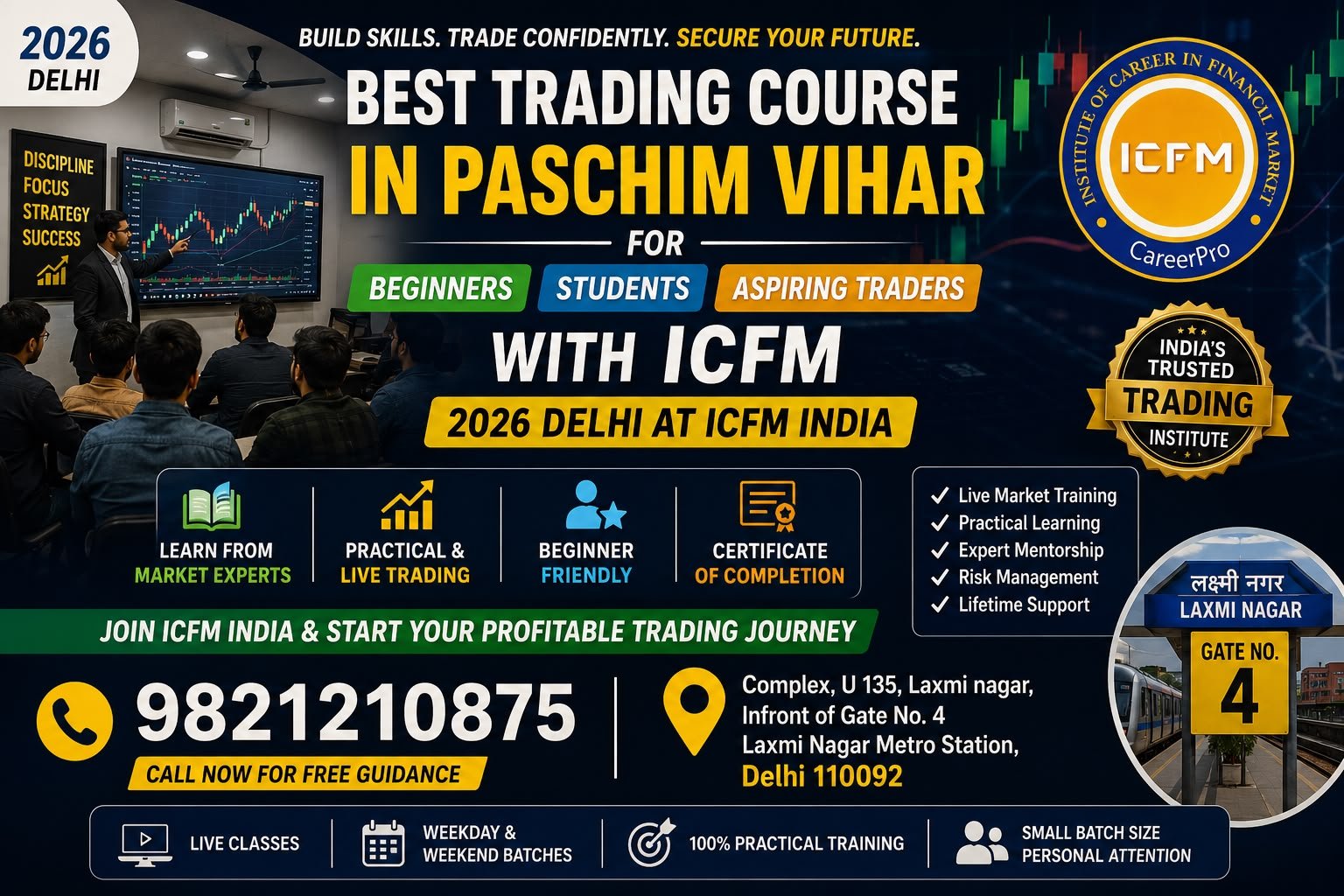
Looking for the best trading course in Paschim Vihar? ICFM offers practical stock market training covering technical analysis, equity trading, derivatives, risk management, trading strategies, and market tools. Build real-world financial market skills with structured learning and expert guidance at ICFM, Delhi.
Choosing a trading course is not simply about finding an institute that teaches candlestick patterns or technical indicators. A useful trading education should help you understand how financial markets work, how to interpret price behaviour, how to manage risk, and how to make decisions using a structured process.
For learners searching for the best trading course in Paschim Vihar, ICFM provides a practical learning environment focused on stock-market education, technical analysis, trading strategies, derivatives, investment concepts and professional market skills.
ICFM has been providing financial-market education in Delhi and offers courses covering areas such as equity trading, technical analysis, derivatives, swing trading, professional trading and broader financial-market training. Its published course information also highlights practical training, experienced faculty and access to trading tools and software.
The objective is straightforward: help learners move beyond random tips and develop a more disciplined understanding of trading and investing.
Why Learning Trading Properly Matters
The stock market can appear simple when viewed through a mobile trading application. Buying or selling a stock may take only a few seconds. The difficult part is understanding why a trade should be taken, where the risk lies, and when the trade should be avoided.
New traders commonly struggle with:
- Entering trades without a defined setup
- Depending on market tips instead of analysis
- Using excessive leverage
- Ignoring stop-loss levels
- Trading emotionally after a loss
- Confusing investing with short-term trading
- Following indicators without understanding price behaviour
- Taking too many trades in a single session
A quality trading course should address these problems through structured education and practice.
That is where professional training can make a meaningful difference.
What Makes a Trading Course Worth Choosing?
When comparing trading institutes in Delhi, students should look beyond phrases such as “best trading institute” or “100% profitable strategy.”
Instead, evaluate the actual learning experience.
1. Does the course begin with fundamentals?
A beginner should first understand:
- Equity markets
- NSE and BSE
- Market participants
- Demat and trading accounts
- Order types
- Bid and ask prices
- Market and limit orders
- Trading sessions
- Corporate actions
- Basic market terminology
Without these fundamentals, advanced strategies can become difficult to apply correctly.
2. Does the course teach technical analysis?
Technical analysis is an important part of short-term and positional trading education.
A structured program should cover:
- Candlestick analysis
- Support and resistance
- Trend identification
- Chart patterns
- Volume analysis
- Moving averages
- Momentum indicators
- Breakouts and breakdowns
- Price action
- Entry and exit planning
ICFM's published course offerings include dedicated technical-analysis and equity-trading programs, alongside broader professional trading courses.
3. Is risk management included?
A trader can have a good strategy and still lose money by managing risk poorly.
Professional trading education should therefore include:
- Position sizing
- Stop-loss planning
- Risk-to-reward concepts
- Capital allocation
- Trade management
- Portfolio diversification
- Trading discipline
The purpose is not to eliminate market risk. That is impossible.
The purpose is to teach traders how to recognize, measure and manage risk before entering a position.
ICFM Approach to Trading Education
ICFM focuses on combining financial-market concepts with practical learning. Its published information highlights a practical approach in which learners work with trading software and market-related tools rather than relying exclusively on classroom theory.
The institute offers a range of courses for different learning objectives, including:
- Equity Trading
- Technical Analysis
- Swing Trading
- Derivatives Trading
- Professional Trading
- Algorithmic Trading
- Financial Market Professional programs
This allows students to choose a learning path according to their current knowledge and career objective.
Best Trading Course in Paschim Vihar: What You Can Learn
A well-designed trading education can take a learner through several stages.
Stage 1: Understand the Market
Before developing a strategy, students need to understand the environment in which trading takes place.
Topics can include:
- Indian stock-market structure
- Equity and derivatives
- Exchanges
- Market participants
- Trading terminology
- Order execution
- Market trends
- Basic economic factors
This creates the foundation for more advanced concepts.
Stage 2: Learn to Read Charts
Charts provide a visual representation of market price and volume.
Students can learn how to identify:
Price Trends
Understand whether the market is moving upward, downward or sideways.
Support and Resistance
Identify areas where price may react based on previous market behaviour.
Candlestick Structures
Study individual candles and combinations to understand market sentiment.
Chart Patterns
Learn how formations can provide potential trading setups when combined with other evidence.
Volume
Use volume as an additional confirmation tool rather than relying on price alone.
Stage 3: Develop a Trading Strategy
Learning individual indicators is not the same as learning a trading strategy.
A strategy should answer important questions:
When should I enter?
What market conditions must exist before taking a trade?
Where should I exit if the trade goes against me?
A predefined stop-loss can help establish the maximum acceptable risk.
Where will I book profit?
A trader should have a logical exit plan rather than making decisions purely from emotion.
How much capital should I risk?
Position sizing is an essential part of responsible trading.
When should I avoid trading?
Sometimes the best trade is no trade.
This systematic approach is far more useful than simply collecting dozens of indicators.
Stage 4: Technical Analysis for Real-World Decision Making
Technical analysis can be used for different trading timeframes.
Intraday Trading
Focuses on opportunities within the same trading session.
Students may study:
- Intraday charts
- Price action
- Breakouts
- Volume
- Momentum
- Entry and exit planning
Swing Trading
Swing trading generally focuses on capturing market movements over several sessions or weeks.
ICFM currently lists a dedicated Swing Trading Course covering swing-trading techniques, technical analysis and market behaviour.
Positional Trading
This approach focuses on holding positions for a longer period based on technical and/or fundamental analysis.
The appropriate approach depends on the trader's objectives, risk tolerance, available time and experience.
Stage 5: Understanding Futures and Options
Derivatives can provide opportunities, but they also introduce additional complexity and risk.
A serious trading course should therefore explain:
- Futures contracts
- Options contracts
- Call and put options
- Strike prices
- Expiry
- Premium
- Intrinsic and time value
- Option-chain concepts
- Hedging
- Leverage
- Derivative risk management
ICFM publishes dedicated derivatives and options programs, including its Certified Derivatives Trader and A to Z Options offerings.
Students should understand derivatives before attempting to trade them independently.
Trading Psychology: The Skill Many Beginners Ignore
A strategy may look excellent on paper, but emotions can change how a trader executes it.
Common psychological problems include:
- Fear after a losing trade
- Greed after a profitable trade
- Revenge trading
- Overtrading
- FOMO
- Moving stop-losses
- Increasing position size after losses
- Closing profitable trades too early
A professional learning program should therefore treat discipline and psychology as trading skills, not optional topics.
The goal is to develop a process where decisions are based on predefined rules rather than momentary emotions.
Practical Learning Instead of Only Classroom Theory
One of the important differences between basic financial education and trading education is practical exposure.
Students need opportunities to understand how concepts appear in actual market conditions.
ICFM states that its practical approach includes students working with personal computers from the beginning of training and using trading-related software and infrastructure.
Practical learning can help students understand:
- How charts behave in real time
- How orders are placed
- How price moves affect positions
- How technical setups develop
- How news can influence markets
- How risk changes with position size
- How to maintain a trading journal
The objective should be skill development, not promises of guaranteed returns.
Who Can Join a Trading Course in Paschim Vihar?
A structured trading program can be useful for different types of learners.
College Students
Students interested in finance can develop practical market knowledge alongside their academic education.
Fresh Graduates
A stock-market certification can complement a finance-related career path and help graduates understand the practical side of financial markets.
Working Professionals
Professionals can learn market concepts and explore trading or investment as an additional financial skill.
Aspiring Traders
Those who want to develop trading skills can learn technical analysis, risk management and strategy development in a structured environment.
Investors
Long-term investors can benefit from understanding financial statements, valuation, market cycles and portfolio concepts.
Career Switchers
Professionals considering a transition into finance can use structured financial-market education to build foundational knowledge.
Trading Course for Beginners in Paschim Vihar
If you are completely new to the stock market, do not worry about starting with advanced strategies.
A sensible learning sequence is:
Step 1: Understand the financial markets
Step 2: Learn equity trading fundamentals
Step 3: Study technical analysis
Step 4: Understand fundamental analysis
Step 5: Learn risk management
Step 6: Practice chart analysis
Step 7: Develop a trading plan
Step 8: Study derivatives only after understanding their risks
Step 9: Maintain a trading journal
Step 10: Gradually build independent decision-making skills
This progression is more sustainable than attempting to learn every strategy simultaneously.
How to Choose the Best Trading Course in Paschim Vihar
Before enrolling in any institute, ask these questions:
Is the curriculum clearly defined?
A good course should explain what you will learn rather than simply advertising “advanced trading.”
Is practical training included?
Look for opportunities to apply concepts through charts, market examples and trading tools.
Are risk-management concepts taught?
This should be a core component, not an afterthought.
Does the institute have experienced faculty?
Instructor experience can significantly influence the quality of practical learning.
Are different market segments explained?
Depending on your objective, you may want exposure to equity, derivatives, technical analysis, fundamental analysis and other market segments.
Is there support after the classroom session?
Access to faculty guidance can be valuable when students encounter questions while practising.
Why ICFM Can Be Considered by Learners from Paschim Vihar
ICFM is based in Delhi and provides stock-market and financial-market education across multiple course categories. Its published course information highlights experienced faculty, practical training, trading software and support for learners.
For learners searching specifically from Paschim Vihar, the institute's Delhi location makes it an option worth considering, particularly for students who are comfortable travelling to its Laxmi Nagar centre or using available online/hybrid learning formats.
ICFM Delhi Centre
ICFM – Institute of Career in Financial Market
Address: Complex, U 135, In Front of Gate No. 4, Laxmi Nagar Metro Station, Laxmi Nagar, Delhi – 110092
Phone: +91 9821210875
Email: info@icfmindia.in
Website: www.icfmindia.in
You can explore ICFM's current courses and training options on its official website. ICFM India – Official Website
What Makes a Career in Financial Markets Different?
A career in the financial markets is broader than becoming a trader.
Depending on qualifications, skills and experience, learners may explore areas such as:
- Equity dealing
- Technical analysis
- Research
- Investment operations
- Trading support
- Portfolio support
- Financial advisory
- Wealth-management support
- Derivatives
- Market education
- Independent trading and investing
The right career path depends on an individual's education, skills, certifications, experience and professional requirements.
Learn Before You Trade
The stock market offers opportunities, but it also involves substantial financial risk.
No genuine course can guarantee profits from trading. Market conditions change, strategies can fail, and even experienced traders experience losses.
The purpose of professional education is therefore not to promise guaranteed returns.
It is to help learners understand:
Market + Strategy + Risk + Discipline + Practice
When these elements are approached together, students can make more informed decisions and develop a stronger foundation for their financial-market journey.
Start Your Stock Market Learning Journey with ICFM
If you are searching for the best trading course in Paschim Vihar, focus on the quality of education rather than marketing claims.
Look for practical training, structured curriculum, experienced faculty, technical and fundamental analysis, risk management, market tools and continued guidance.
ICFM offers a broad selection of stock-market courses, from equity trading and technical analysis to swing trading, derivatives and professional trader programs.
For students and aspiring traders in Paschim Vihar, this can provide a structured starting point for developing practical financial-market knowledge.
Enrol with ICFM
ICFM – Institute of Career in Financial Market
Centre: Laxmi Nagar, Delhi
Address: Complex, U 135, In Front of Gate No. 4, Laxmi Nagar Metro Station, Laxmi Nagar, Delhi – 110092
Phone: +91 9821210875
Email: info@icfmindia.in
Website: www.icfmindia.in
Learn the market. Understand the risk. Build the skill.

ICFM Admin
Senior Trading Analyst at ICFM India
Rahul Rai is a certified market professional with over 12 years of experience in equity and derivatives trading. He specializes in technical analysis and margin trading strategies, and has trained over 5,000 students through ICFM India's certification programs.